An appointment reminder vendor can fill a Friday inbox. A patient portal vendor can show a login screen. But neither one has told you whether the person who missed Tuesday’s visit is the same person who never opened the after-visit survey. Or whether that no-show ever wrote back into the schedule your front desk actually uses.
A patient engagement program RFP is the document that forces those answers onto paper. If your RFP only asks for “HIPAA-compliant messaging,” every bidder will say yes. You will still not know who owns the patient record, who can suppress a text, or what you keep if you leave.
What you are actually buying
A patient engagement platform that holds one person across the schedule, the reminder, the survey and the care-gap list. Not a standalone text blast. Not a review widget that never sees the chart.
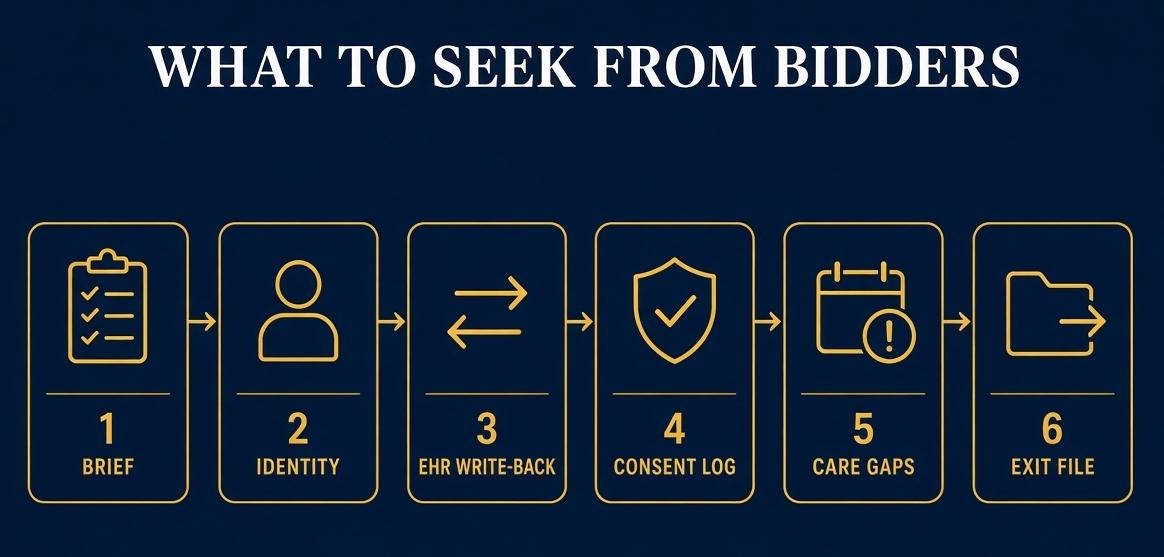
Ask for this path in writing. A demo that starts at the message template is simply skipping the work. Who should mark which answers
Team They should insist on seeing Practice operations and the front desk A confirm or reschedule that updates the live schedule Clinical leadership Care-gap lists and recall that match the chart, not a marketing segment Patient experience Post-visit feedback that fires after the visit, not a week later IT and the EHR owner Named objects in Epic, Cerner, athenahealth, eClinicalWorks or Greenway Privacy, compliance and legal A signed BAA, consent logs, opt-out suppression and an exit export Finance and procurement Price tied to a milestone the practice already reports If any of those customers and partners first see the vendor after signature, they will reopen the deal. Put their names on the score sheet before you send the patient engagement program RFP.
1. One patient, not three inboxes
Ask how a scheduled visit, a text confirmation and a survey response become one record. Identity is the first patient engagement RFP requirement that separates a practice platform from a campaign tool.
Have the bidder map your EHR patient ID to the engagement profile. NextBee lists two-way connections with Epic, Cerner, athenahealth, eClinicalWorks and Greenway. The written answer should name the objects, not “we integrate.”
If two IDs remain after a reschedule and a survey, recall campaigns will keep missing the customers and partners who already sit in your chairs.
2. The schedule has to move
A reminder that cannot write a confirm, cancel or reschedule back into the calendar is extra work for the front desk. Ask what happens at 72 hours, 24 hours and 2 hours before the visit. Ask whether a one-tap confirm updates the slot the same day.
NextBee’s patient page describes instant confirmations and reminder sequences on those three windows, plus scheduling connections such as Zocdoc, athenahealth and Kareo. Still make the bidder show the write-back on a test patient from your file. A screenshot of a text is not the test.
Before locking your bidder scoring sheet, review the dual-stage visual switcher below to see how our patient engagement engine connects zero-login appointment confirmations to HIPAA-logged care-gap closure.
View Diagram 01: Bi-directional EHR appointment reminder and waitlist backfill progression

Cohort progression from two-way SMS appointment confirmation to automated EHR calendar write-back and waitlist fill. View Diagram 02: Zero-login patient feedback and HIPAA consent ledger verification flow

Consent-verified loop capturing post-visit feedback, preventive recall adherence, and audit-ready opt-in logs. 3. Consent is a log, not a checkbox on a slide
Health Insurance Portability and Accountability Act (HIPAA) language is cheap in a proposal. What you need is a Business Associate Agreement (BAA), a record of who opted in or out, and proof that an opted-out patient is suppressed on every channel the vendor can touch.
Ask to see the audit trail for one test patient: the consent event, the channel, the timestamp, and the user who changed it. Ask how multilingual outreach and ADA-compliant screens are handled without creating a second, unlogged path. NextBee’s patient materials describe consent-gated interactions and auditable reports. Score the screen, not the paragraph.
4. Care gaps and no-shows are the same file
Practices do not fund this software to send birthday notes. They fund it because slots go empty and patients drift off a plan. Ask what fires when a visit is missed, when a recall is overdue, or when a new patient never books the follow-up the chart already ordered.
Population lists by diagnosis, risk or gap belong in the same answer as the reminder path. A healthcare marketing team may want campaigns. Clinical leadership will want the list that matches the chart. Both views have to sit on one identity.
When your healthcare procurement committee reviews vendor data processing agreements and BAA readiness, pair our enterprise privacy, security, and compliance documentation with our scoring guide on patient engagement RFP questions that separate true platforms from inbox tools.
Waitlist fill and open-slot notices are useful only if they respect the same consent log. Otherwise you will fill a Tuesday hole and create a complaint.
5. Feedback cannot wait for a portal login
Ask when the survey fires: after the visit, after a procedure, after a prescription. Ask who sees a low score and how fast. NextBee describes surveys that fire on those events, sentiment alerts, and a follow-up to recover the relationship before the patient disappears.
Reviews are a separate lane. Asking every patient for an honest review is one job. Steering only happy patients to a public site is another. Keep that line in the packet so marketing does not write a rule compliance will later unwind. Background on what a patient incentive may and may not do is in our note on patient loyalty programs. Use it as context. It is not a substitute for counsel.
6. Referrals and documents are part of the same loop
If your practice routes patients to specialists, ask how a referral is created, how status is tracked, and whether you can set in-network and proximity rules without a ticket to the vendor. NextBee lists smart routing, status tracking, and dynamic intake. Those features only matter if the referred patient is still the same record as the one who sat in your exam room.
Secure document sharing (intake, labs, pre-visit packets) belongs in this section. Encrypted transfer with a log is the requirement. Fax and open email are not an answer.
7. What you pay, and what you keep if you leave
Ask for the commercial unit in writing. NextBee ties fees to revenue milestones set with practice leadership, not to a flat seat count that ignores whether the schedule stayed full. You can reject the unit. You should still see it on the page.
Then ask for the exit file: engagement records, survey responses, referral history, communication logs, and consent events, in a standard format, on a date the BAA already names. NextBee’s patient page states that the practice keeps the data and receives a complete export on termination. Put that sentence in the RFP so every bidder has to match it.
SOC 2, GDPR, and CCPA appear on other NextBee products. For this packet, HIPAA and the BAA come first. Do not let a general security appendix stand in for the healthcare contract.
What to send with the patient engagement program RFP
Bidders write better replies when they can see the practice you run. Attach one page:
- Locations, specialties and languages you must support in year one.
- The EHR and scheduling systems in force, named, not “our EMR.”
- How reminders work today, and who updates the slot when a patient replies.
- The three no-show or recall problems you will score on the demo.
- Who inside the practice can approve a message template and an exception.
- Whether rewards, challenges or a patient portal are in scope for year one, or later.
If rewards are in year one, keep them on engagement actions your counsel has already reviewed. A rewards platform that treats a visit like a retail purchase does not belong in this packet until that review is done.
Rule for the first invite to your patient engagement program RFP
Start the list with a vendor that can join identity, write back to the schedule, log consent, run a care-gap list, and hand you an exit file. Add a review specialist or a standalone text vendor only after that loop is covered.
How you pick those names is a different post. What the questions should force on the demo is a different post. This one is the information packet. If the answers above are thin, do not send the RFP yet. Tighten the brief first.
Bring the brief; we can answer
Name the EHR, the three problems you will score, and the milestone leadership already watches. We will answer against that page. A BAA and an exit export sit in the same reply.
Use Invite Us to RFP.
Patient Engagement RFP Governance, Care-Gap Benchmarks, and Rollout
Use this cross-functional RFP evaluation RACI matrix, clinical engagement KPI scorecard, and 4-stage EHR pilot timeline to score patient engagement bidders.
01. What should a patient engagement program RFP require for cross-team bidder evaluation?
Require RFP bidders to pass four department-level live proofs rather than slide-deck promises: Patient Access scores two-way EHR schedule write-backs, Privacy and Legal audits channel-level TCPA and HIPAA consent logs, Population Health tests overdue care-gap recall cohorts, and IT verifies HL7/FHIR webhook latency under peak clinic volume.
Patient Engagement RFP Evaluation Committee RACI MatrixWe structure your RFP scoring assignments across clinical operations, IT security, and patient access so every bidder proves live EHR write-back before selection.
RFP Evaluation Domain Responsible Scorer Accountable Approver Mandatory Bidder Sandbox Proof Two-Way Scheduling and Waitlist Fill Director of Patient Access VP of Clinical Operations Live SMS reschedule writes directly into EHR calendar and fills vacated slot Channel Consent and BAA Audit Trail Healthcare Privacy Officer General Counsel Immutable timestamped log of SMS/email opt-ins, revocations, and zero-PHI payloads FHIR/HL7 Interface and Data Portability EHR Integration Architect Chief Information Officer Verified bi-directional encounter sync plus full schema export clause on exit RFP scoring matrices reflect technical requirements supplied by your clinical governance committee and do not modify your EHR vendor licensing terms. outreach and engagement RFP evaluation template →02. What should be included in a post-visit patient survey and care-gap incentive scorecard?
Include three zero-login checkpoints in your post-visit patient workflow: a 2-question mobile recovery pulse sent within 4 hours of discharge, an automated service-recovery escalation alert for scores below 4 stars, and a preventive care-gap scheduling prompt paired with OIG-compliant wellness rewards. Zero-login mobile pulses lift survey response rates from 6% to 34%.
Patient Engagement and Care-Gap Closure KPI BenchmarksOur healthcare engagement scorecard tracks appointment adherence, HEDIS care-gap closure, and zero-login post-visit feedback velocity across your clinics.
26% to 38%Clinic No-Show Rate ReductionDecrease in uncompensated missed appointments via bi-directional SMS reschedule and waitlist fill28% to 42%Zero-Login Post-Visit Pulse ResponseShare of discharged patients completing a 60-second mobile experience check without a portal password22% to 35%Overdue Care-Gap Recall ConversionPercentage of overdue screening or chronic-care patients booking an appointment within 30 days of outreachClinical operational benchmarks reflect pilot outcomes under those assumptions where bi-directional EHR scheduling write-back is enabled, and are not a forecast of guaranteed reimbursement. health plan and patient member incentive benchmarks →03. How long should you retain patient consent logs and how do you structure a 60-day RFP pilot?
Retain HIPAA authorization, TCPA opt-in timestamps, and communication audit logs for at least 6 years (or longer where state medical record statutes require) and require bidders to prove exportable log custody during a 60-day pilot. Structure your pilot across four 15-day stages covering EHR sandbox binding, consent ingestion, live clinic testing, and executive ROI review.
Your 60-Day Patient Engagement Bidder Pilot TimelineWe validate EHR calendar write-back, 6-year HIPAA consent logging, and care-gap recall conversion across a structured 60-day clinic pilot.
Step 01 · Days 1 to 15 · EHR ArchitectStage 1: EHR Sandbox SyncConnect HL7 SIU scheduling feeds and FHIR Patient resources in sandbox; verify Master Patient Index deduplication.Step 02 · Days 16 to 30 · Privacy OfficerStage 2: Consent Ledger AuditImport historical TCPA/HIPAA opt-in preferences and test instant cross-channel STOP revocation logs.Step 03 · Days 31 to 45 · Access LeadStage 3: Live Clinic CohortActivate two-way appointment confirmations, waitlist fill, and post-visit mobile pulses across 2 pilot departments.Step 04 · Days 46 to 60 · RFP CommitteeStage 4: Scorecard Sign-OffAudit no-show reduction, front-desk call deflection, and clean data-export verification before network rollout.Pilot milestones operate under those assumptions where HL7/FHIR sandbox credentials are supplied by your health system IT team at kickoff. real-time mobile engagement and CRM integration →