Text messages feel urgent and personal. Emails feel roomy and flexible. Both work, but not for the same things. A long promotion sent by text can annoy customers. An urgent delivery update sent by email may be seen too late. The SMS vs. email marketing question isn’t about picking a winner. It’s about matching each message to the channel that suits it.
This guide compares SMS vs. email marketing side by side and maps common messages to the best channel. It also covers the consent rules for each, so you can plan a channel mix that customers welcome.
Use SMS for short, time-sensitive messages customers need to see now, such as delivery alerts, appointment reminders and last-chance offers. Use email for richer content that can wait, such as newsletters, product education and detailed receipts. Get clear consent for texts, and let customers choose how they hear from you.
SMS vs. Email Marketing at a Glance
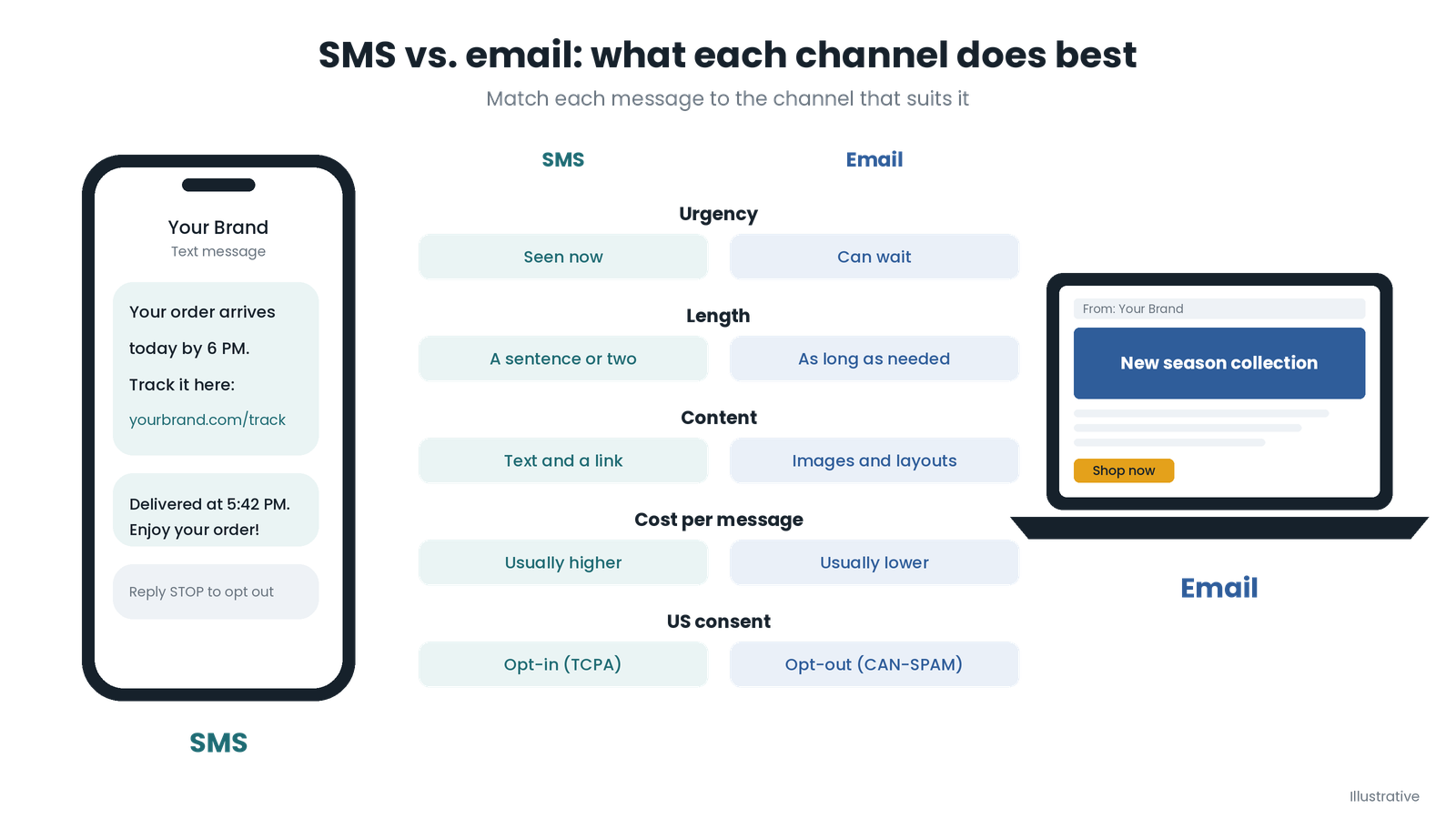
SMS Email Best for Urgent, short and timely messages Detailed, visual and less urgent messages Length A sentence or two As long as the content needs How fast it’s seen Usually within minutes Often hours later Content Mostly text and a link Images, layouts, several links Cost per message Usually higher Usually lower Tolerance for frequency Low, since it feels personal Higher Consent in the US Stricter, under the TCPA Opt-out based, under CAN-SPAM Most businesses need both. Omnichannel customer engagement software coordinates them, so each customer gets the right message on the right channel. It also prevents the same message from arriving twice.
SMS vs. Email Marketing: When SMS Is the Better Choice
Text messages shine when timing matters and the message is short. They’re read on the device customers carry everywhere, so they suit moments that can’t wait.
Choose SMS for
- Delivery and order status updates
- Appointment and reservation reminders
- Flash sales ending today
- Quick two-way replies, such as “Reply YES to confirm”
Watch out for
Sending too often. A text feels personal, so customers notice quickly when they’re getting too many, and they opt out.
SMS vs. Email Marketing: When Email Wins
Email gives you space. It suits content that needs images, explanation or several options, and messages customers may want to read later or keep.
Choose email for
- Newsletters and product education
- Detailed receipts and account statements
- New collections and catalog-style promotions
- Onboarding series and how-to guides
Watch out for
Relying on email for anything urgent. Messages can sit unread in a busy inbox or land in a promotions folder.
Which Channel for Which Message
This table applies SMS vs. email marketing thinking to common messages, showing the channel that usually fits best. Treat it as a starting point, then adjust based on how your customers respond.
Message Best channel Why Order shipped or delivered SMS Short and time-sensitive Appointment reminder SMS, with an email confirmation Needs to be seen, plus a record to keep Monthly newsletter Email Longer and visual Flash sale ending today SMS Urgency matters New product launch Email, with an SMS teaser for top customers Needs detail and images Detailed receipt Email Customers want to keep it Loyalty points update Email or app, with SMS for milestones Routine updates can wait Subscription renewal reminder Email first, SMS if unopened Detail first, a nudge if missed Win-back offer Email, then SMS for high-value customers Balances cost and reach Renewal reminders are a good example of using both. Membership renewal software can send a detailed email first, then follow up with a short text only if the email isn’t opened.
To personalize visual newsletter blocks alongside instant text notifications from one unified profile, pair our dynamic content spotlight and messaging module with our architectural comparison of omnichannel vs. multichannel marketing workflows so your buyers never receive duplicate prompts.
The Consent Rules for Each Channel
The SMS vs. email marketing choice also depends on the rules. In the US, texting is regulated more strictly than email.
SMS: the TCPA
- Marketing texts sent with automated systems generally require the customer’s prior express written consent.
- Under FCC rules, customers can opt out by any reasonable means, such as replying STOP.
- Opt-out requests must be honored within 10 business days.
Email: CAN-SPAM
- US law doesn’t require opt-in, but every marketing email needs a clear way to opt out.
- Opt-outs must be honored within 10 business days.
- Messages need accurate sender details and a valid postal address.
The visual model below maps out how our omnichannel routing engine sequences urgent SMS alerts, rich email digests, and mobile push fallbacks without message fatigue.

Stage Flow: Urgency and consent evaluation, primary email or SMS dispatch, and 24-hour non-opener fallback routing. These points summarize US federal rules. The FTC’s CAN-SPAM compliance guide covers email in full. Some states add rules for texting, such as limits on sending hours, and other countries have their own laws. Check with counsel before launching a texting program.
Where Push Notifications Fit
If you have a mobile app, push notifications add a third option. They’re free to send and appear on the lock screen like a text. However, they only reach customers who installed your app and allowed notifications. Push works well for app activity, such as new rewards, saved-item price drops or a streak about to end. A mobile app engagement platform coordinates push with SMS and email, so customers aren’t contacted three ways about the same thing.
Building a Smart Channel Mix
The best SMS vs. email marketing strategy uses each channel for what it does best. These four rules help.
- Start with one channel per message. Send each message on its best-fit channel, not everywhere at once.
- Fall back only when needed. If an important email isn’t opened, a short text can follow.
- Let customers choose. A simple preference center lets customers and partners pick which messages they get, and on which channel.
- Cap how often you send. Set limits per channel, especially for SMS, and respect quiet hours.
For ideas on the loyalty messages that often fill these channels, see our ecommerce loyalty program guide.
How to Measure Each Channel
Click and conversion rate: how many recipients act on each message, by channel.
Opt-out rate: a rising rate on SMS usually means you’re sending too often.
Cost per conversion: compare what each channel costs for the results it brings.
Revenue by message type: see which messages earn their place on the costlier channel.
Choosing Between SMS and Email, Message by Message
SMS vs. email marketing works best as a partnership. Texts carry the urgent, short moments. Emails carry the rich, lasting ones. Get consent right, let customers choose their channels and coordinate everything, so each message arrives where it’s most welcome.
Reach customers on the channel that fits
Our retention platform flags customers who are losing interest. It then runs win-back journeys that choose the right channel for each step, from email to text. Loyal customers can earn VIP perks, and one view shows retention across every channel.
SMS and Email Routing Rules, Unit Economics, and Campaign Governance
Use these unit economics tables, routing matrices, and workflow comparisons to match every customer message to the highest-margin channel.
01. How do you sequence SMS and email in an omnichannel lifecycle program to protect per-message unit economics?
Send rich educational content, monthly point statements, and early-bird renewal notices via email at $0.001 per send, then trigger a concise SMS fallback at $0.015 per segment only for non-openers within 48 hours of reward expiration. This cascade cuts total messaging spend by 55% while lifting redemption velocity.
Email-First vs. SMS-Escalation Unit EconomicsWe route high-volume updates through email and reserve SMS for high-urgency conversion windows to maximize your ROAS.
Lifecycle Message Type Primary Channel Cost (Per 10k) Fallback Escalation Rule Net Conversion and Cost Impact Monthly Point Balance Digest $12 via Dynamic HTML Email SMS only if >$15 reward expires in 72h 64% Lower Send Cost; 28% Burn Rate Post-Delivery Reorder Prompt $12 Email + App Push at Day 21 SMS 1-Click Reorder at Day 26 if Unopened 3.4x Higher Repeat Order Velocity VIP Flash Drop or Text-to-Win $140 Direct SMS to Opted-In VIPs Email Recap with Extended Bundle Offer 19% Same-Day Checkout Conversion Carrier segment rates and conversion figures are illustrative under those assumptions and do not predict telecom pass-through fees across all regions. omnichannel customer engagement and routing platform →02. How do you evaluate text-to-win and SMS marketing software for compliance and carrier deliverability?
Verify automated 10DLC campaign registration, strict TCPA double opt-in logging, local time-zone quiet hours (8 AM to 8 PM recipient time), and instant STOP/HELP keyword handling. Configure decision rules that automatically route unsubscribed SMS profiles to email or mobile wallet notifications without dropping them from journeys.
Omnichannel Channel Selection and Consent Decision EngineOur messaging engine checks TCPA consent, local quiet hours, and recent email engagement before selecting a delivery channel.
Urgent Window (<24 Hours) + Verified SMS Opt-In Dispatch concise 160-character SMS with shortened tracking link during recipient daytime window. Long-Form Onboarding or Receipt Summary - Send personalized HTML email with visual progress bar
- Track link clicks for 48 hours
- Suppress SMS if email link is clicked
Recipient Replies STOP or Lacks SMS Consent Immediately revoke SMS flag, log immutable compliance timestamp, and route future alerts to email and wallet pass. 3 Consecutive Unopened SMS Messages Downgrade SMS frequency to quarterly critical alerts to preserve sender reputation and cut carrier costs. Consent gates enforce rule configurations supplied by your legal team and do not replace formal TCPA, CTIA, or GDPR compliance counsel. compliant text-to-win and SMS promotions software →03. What KPIs measure post-purchase engagement success across coordinated SMS and email workflows?
Measure revenue per recipient after carrier fees, 30-day SMS opt-out rate (keep below 1.2% per campaign), cross-channel attribution lift, and time-to-second-order velocity. Unifying SMS and email inside one post-purchase engine prevents embarrassing duplicate blasts after a customer has already reordered.
Siloed SMS and Email Tools vs. Unified Lifecycle MessagingWe unify your SMS, email, and loyalty triggers so every customer receives one coordinated conversation.
Manual Spreadsheet Workflow- Separate SMS and email tools blast the same 15% promo code 10 minutes apart, doubling messaging cost.
- Customers who already completed a purchase via email still receive a scheduled SMS reminder the next morning.
- Marketing cannot tell whether SMS clicks cannibalized organic email orders or drove true incremental lift.
Our Automated Playbook Execution- Our unified journey canvas staggers email and SMS by 48 hours and suppresses redundant sends automatically.
- Our real-time order webhook cancels pending texts the second a checkout or reward claim completes.
- Our holdout analytics isolates true incremental revenue per channel net of SMS carrier segment fees.
Deliverability and opt-out benchmarks reflect historical lifecycle campaigns under those assumptions rather than promise carrier throughput. post-purchase customer engagement software →