
Brands that sell through partners often help pay for those partners’ marketing. The two most common ways to do it are market development funds and co-op funds. They sound similar, and many teams use the terms loosely, but they work differently.
This guide explains MDF vs. co-op in plain terms: how each type of fund is earned, what it pays for and how claims work. It also walks through an example and shows how to run both programs without losing track of the money.
In this guide
MDF vs. Co-op: The Definitions
Market development funds (MDF)
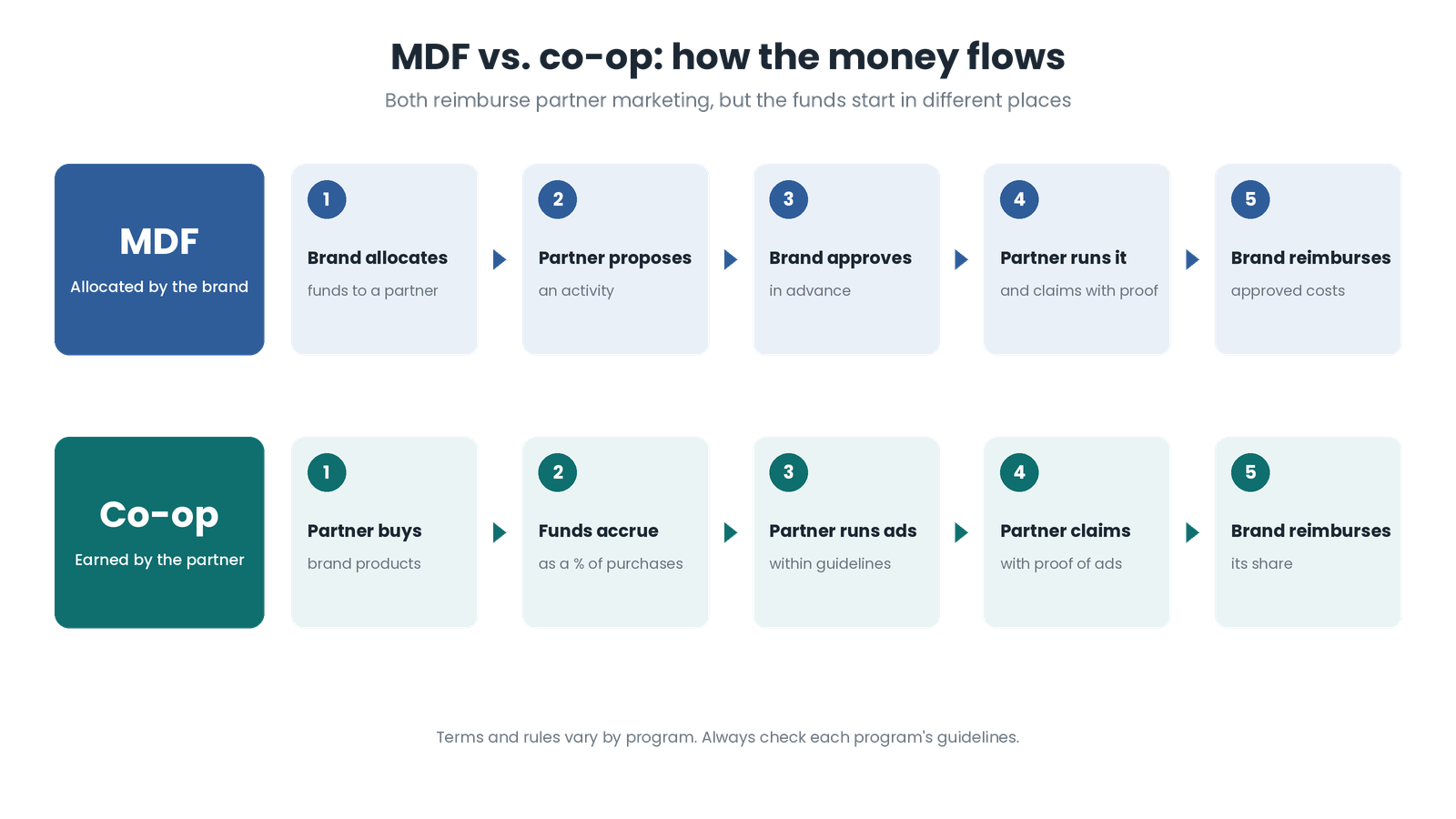
Money a brand sets aside and allocates to selected partners for specific marketing activities. The brand usually decides who gets MDF and how much, often based on a partner’s tier, potential or marketing plan. Partners typically propose an activity, get approval and then claim reimbursement.
Co-op funds
Money a partner earns, or accrues, as a percentage of what it buys from the brand. The brand then shares the cost of the partner’s advertising that features its products. Partners claim reimbursement after running approved ads, with proof that the ads ran.
The simplest way to remember it: MDF is allocated by the brand, while co-op is earned by the partner.
Both programs usually run through a partner enablement platform. There, partners can see their available funds, submit requests and track claims in one place.
MDF vs. Co-op Side by Side
MDF Co-op How it’s funded Allocated by the brand Earned as a percentage of partner purchases Who gets it Selected partners Usually every eligible partner that buys Typical uses Events, lead generation, campaigns, training Local ads featuring the brand’s products Approval Usually a proposal approved in advance Ads that follow published guidelines Payment Reimbursed after proof, or sometimes paid up front Reimbursed after proof that the ad ran Main goal Build demand in a market or segment Promote the brand’s products locally Terms vary between companies. Some brands use “MDF” for both types, and program rules differ widely, so always check each program’s guidelines.
An Example: One Partner, Both Funds
Illustrative example
A reseller buys $500,000 of a brand’s products in a year. The brand’s co-op program accrues 2% of purchases, so the reseller earns $10,000 in co-op funds. It uses them to run local ads featuring the brand’s products and claims reimbursement with copies of each ad.
Separately, the brand sees strong growth potential in the reseller’s region. It approves the reseller’s proposal for a $15,000 MDF-funded customer event. After the event, the reseller submits receipts and attendance results to claim the funds.
In this example, the reseller has $25,000 in marketing support. The co-op amount grew with its purchases, while the MDF amount depended on the brand’s view of the opportunity.
How MDF and Co-op Claims Work
Both programs rely on proof of performance, meaning evidence that the approved marketing actually happened.
Request or plan. For MDF, the partner submits a proposal with the activity, budget and expected results. For co-op, the partner checks its available balance and the ad guidelines.
Approval. The brand approves the MDF proposal, or confirms that planned co-op ads meet its guidelines.
Execution. The partner runs the event, campaign or ads.
Claim with proof. The partner submits invoices, ad copies, screenshots or results by the claim deadline.
Reimbursement. The brand checks the claim and pays by credit or payment.
Co-op accruals work much like rebates, since both build up based on partner purchases. Many brands manage them alongside a rebate management platform, so accruals, claims and payouts share one set of records.
When to Use MDF vs. Co-op
Use MDF when you want to
- Enter a new market or segment
- Fund events, lead generation or campaigns
- Invest in partners with high potential
Use co-op when you want to
- Reward partners in line with their purchases
- Keep your products visible in local advertising
- Offer every partner a fair, predictable benefit
Many brands use both. Co-op gives every partner a baseline of support tied to sales. MDF then lets the brand invest more heavily where it sees the biggest opportunity.
Running MDF vs Co-op Programs Well
Channel marketing funds only help if partners use them and brands can see the results. These practices make both programs work better.
Show partners their balance
Partners can’t use funds they don’t know about. Show available co-op and approved MDF in the partner portal.
Make proof easy to submit
Let partners upload invoices and ad copies online, and tell them exactly what counts as proof.
Provide ready-made campaigns
Co-branded templates make it easier for partners to spend funds on approved, on-brand marketing. A channel marketing platform can let partners personalize these assets without starting from scratch.
Remind partners before funds expire
Co-op balances often have a use-by date. A reminder before the deadline helps partners use what they’ve earned.
Measure what the money produced
Track fund usage, claim approval rates and the sales or leads each activity generated, by partner and by activity type.
For more on running accrual-based programs cleanly, see our rebate program best practices, many of which apply to co-op funds too.
MDF vs. Co-op: The Bottom Line
 The MDF vs. co-op difference comes down to where the money comes from and what it’s for. Co-op rewards partners for buying and keeps your products in their local ads. MDF lets you invest strategically in partners and markets with the most potential. Run both with clear rules, easy claims and visible balances, and your channel marketing budget will work harder.
Get more from your channel marketing funds
Our channel tools support MDF allocation, co-op tracking and claims in one partner portal, with reporting on how each program performs. Walk us through your current MDF and co-op setup. We’ll point out where claims can get simpler and where more of your funds could be put to use.