
Most loyalty programs don’t fail in a way anyone notices. Members keep joining, points keep flowing and the dashboard looks healthy. Meanwhile, the program slowly costs more than it earns.
The loyalty program mistakes that hurt most are rarely dramatic. They’re small design and finance decisions that compound over time. Think of a reward rate set without margin math, points no one tracks as a liability or perks for customers who would have bought anyway. That’s often why loyalty programs fail: not all at once, but a little each quarter. This guide explains where margin leaks, how to spot each problem and what to change.
Key insights
- Reward rate is a margin decision. A “5% back” program can consume a much larger share of gross profit than it sounds.
- Paying for behavior you already had is the costliest mistake. Rewards should change what customers do, not just thank them for it.
- Points are a liability, not just a marketing tool. Finance needs to track them from day one.
- High breakage isn’t free money. It often signals members who have stopped caring.
- Programs drift. Without regular review, costs creep up while impact fades.
I. Design-Stage Loyalty Program Mistakes
These loyalty program mistakes are built in at launch. They’re the hardest to see because the program works exactly as designed.
A. Setting the reward rate without margin math
Many programs copy a familiar formula, such as one point per dollar with 100 points worth $5. That feels like “5% back.” But the real cost depends on your margin, not your revenue.
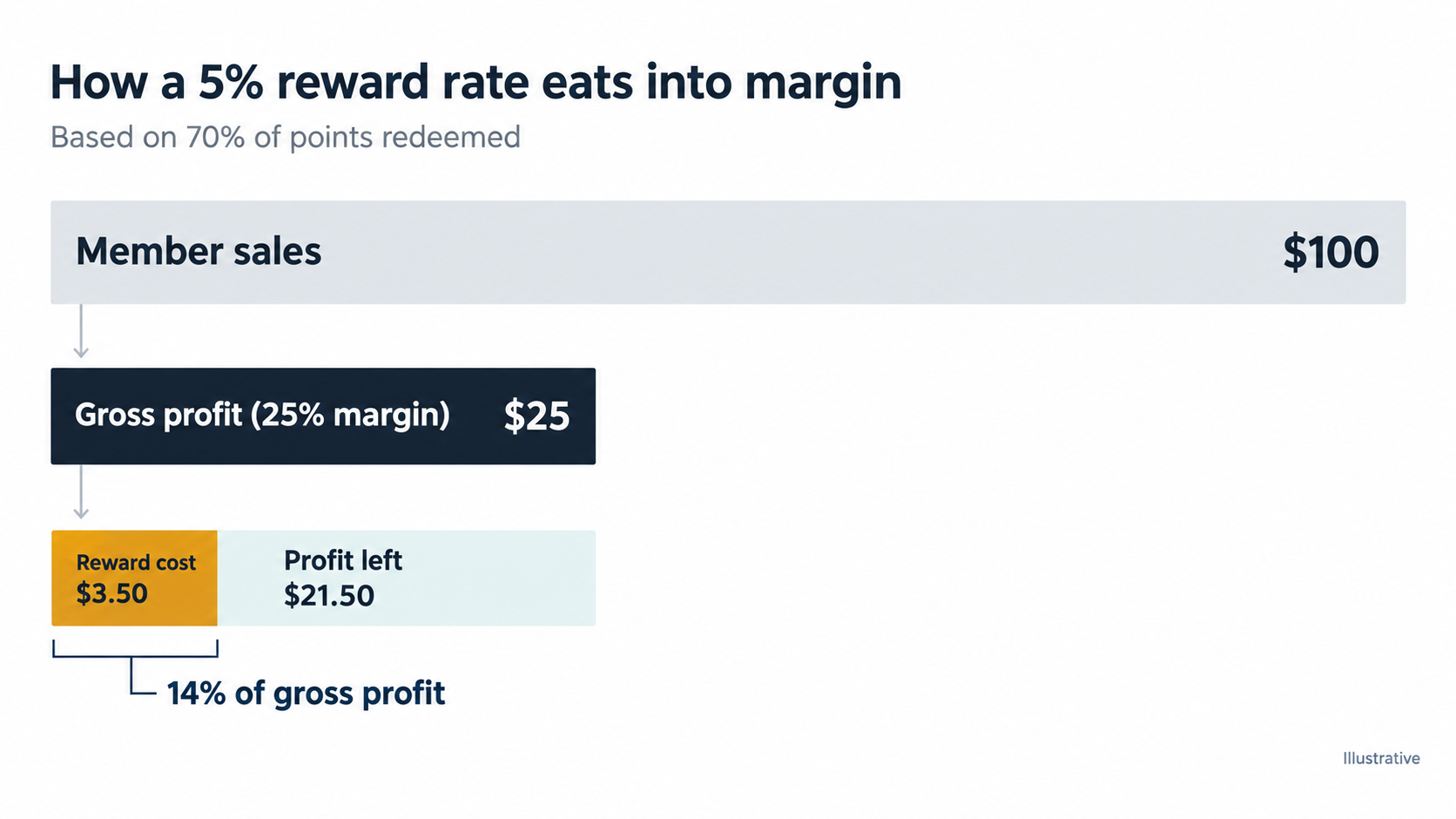
Illustrative example
Say members redeem 70% of the points they earn. The effective reward cost is then 3.5% of member sales. On a product with a 25% gross margin, that 3.5% is 14% of your gross profit. The headline rate sounded small. The margin impact isn’t.
With solid loyalty program software, you can model reward rates by product and segment before launch. You can also set different earning rates for low-margin categories.
The tell: no one can say what share of gross profit the program consumes.
B. Rewarding customers for what they’d do anyway
This is the quietest drain of all. If your most loyal customers would buy the same amount without the program, every point they earn is pure cost. The program should reward changes in behavior, such as a second purchase, a new category or a return after a long gap.
So point bonuses at the actions you want more of. Tie extra rewards to frequency, new categories or reactivation, not just to spend that already happens.
The tell: most rewards go to your top spenders, and their behavior hasn’t changed since they joined.
C. Relying on discounts as the only reward
Cash-off rewards are easy to launch and easy to understand. They’re also the most expensive way to say thank you. Over time, they train members to buy only when a discount is available.
Recognition, early access, free shipping thresholds and experiences often cost less and mean more. Rewarding engagement, such as reviews, referrals or profile updates, adds value too. Customer engagement software can reward these actions alongside purchases, which spreads value beyond pure discounting.
The tell: redemptions spike during promotions and fall flat in between.
D. Overpaying to get members in the door
A large sign-up bonus can inflate member counts quickly. But many of those members join for the bonus, redeem it and never return. You’ve paid acquisition costs for customers who were never going to stay.
Instead, spread the welcome value across the first few purchases. That way, the reward builds a habit rather than ending one.
The tell: a large share of new members redeem their welcome reward and never buy again.
II. Financial Loyalty Program Mistakes Hiding in the Books
The next set of loyalty program mistakes sit with finance. They often surface only at year-end or during an audit.
A. Ignoring points liability
Every unredeemed point is a promise you’ll have to keep. Under revenue accounting standards such as ASC 606 and IFRS 15, points that give customers a material right are a separate obligation. Part of the sale is generally deferred until the points are redeemed or expire. If marketing tracks points and finance doesn’t, the balance sheet won’t reflect what you owe.
The tell: finance learns the size of the points balance from a marketing report.
B. Misreading breakage
Breakage is the share of points that are never redeemed. Some teams treat high breakage as a win, since unredeemed points cost nothing. In reality, very high breakage usually means members don’t value the rewards or have forgotten the program. Very low breakage can mean your program costs more than planned.
Neither extreme is healthy. Track breakage over time, estimate it carefully for accounting and treat sudden changes as a signal worth investigating.
The tell: breakage is celebrated in a budget review but never examined for what it says about engagement.
C. Devaluing rewards without warning
When costs climb, it’s tempting to quietly raise the points needed for a reward. Members notice, and trust drops fast. A sudden devaluation can undo years of goodwill and push your best customers to look elsewhere.
If you must change the value of points, give clear notice, explain why, and offer members a window to redeem at current rates. Also check any legal requirements in your program terms and local consumer rules.
The tell: member complaints and social mentions jump right after a program update.
See the real return on every point
Our platform tracks complete customer journeys to isolate the incremental revenue your program creates. You can compare the cost of every reward against actual margin gains, then adjust earning rules by customer stage and spend level.
III. Operational Loyalty Program Mistakes That Compound
The final group of loyalty program mistakes comes from how the program is run day to day.
A. Leaving the door open to abuse
Wherever points have value, someone will try to game them. Common problems include duplicate accounts, points earned on purchases that are later returned and employees scanning their own cards at the register. Each leak is small. Together, they add up.
Hold points until the return window closes, limit accounts per person and watch for unusual earning patterns.
The tell: a handful of accounts earn far more points than your best real customers.
B. Measuring activity instead of impact
Member counts, points issued and redemptions show activity, not value. To know whether the program earns its keep, compare members with a similar group of non-members. Then look at the difference in spend, frequency and retention.
The tell: every repeat purchase by a member is credited to the program.
C. Setting it and forgetting it
Customer habits change, costs change and competitors change. A program designed three years ago may now reward the wrong things. Review earning rules, reward costs and member behavior at least twice a year. Also watch members whose activity is slowing. Customer retention software can flag them early and trigger outreach before they drift away for good.
The tell: nobody can remember the last time the earning rules changed.

Where each mistake shows up
Diagnosis view
Mistake Where it hits First fix Reward rate without margin math Gross margin Model cost by category Rewarding existing behavior Program return Target bonuses at new behavior Discount-only rewards Price perception and margin Add recognition and access perks Oversized welcome bonus Acquisition cost Spread value across early purchases Untracked points liability Balance sheet Share live liability data with finance Misread breakage Revenue estimates and engagement Track breakage trends by segment Unannounced devaluation Member trust Give notice and a redemption window Abuse and fraud Reward costs Hold points through the return window Activity metrics only Budget decisions Compare members with non-members Set and forget Everything, slowly Review rules twice a year Notice how few of these involve the software itself. Most are decisions about who to reward, for what and how to measure it.
IV. The Verdict
Loyalty program mistakes rarely come from bad intentions. They come from programs designed for growth and never revisited for profit. The fix isn’t to spend less on loyalty. It’s to spend with purpose.
Know what share of gross profit your program consumes. Reward new behavior, not just existing spend. Treat points as a liability from day one. Watch breakage for what it says about engagement. And measure members against non-members, every quarter. Get those five right, and most other loyalty program mistakes become easy to catch.
If you want to go further
Components of a high-converting loyalty program
The building blocks that separate programs members use from programs they ignore.
Ecommerce loyalty best practices
Practical guidance for programs that run mainly online.