Briefing note · Procurement and marketing · Community software column
The list is due Friday. That is the only deadline that matters this week. A community platform RFP that leaves the building without a brief, a lane map, and a first vendor will come back as four different products scored as one.
This note is the packet you can hand across the table. It covers what information to seek from bidders, who owns each lane, and which vendor to start with. If the buy is a branded community platform, treat it as software your members will live in. Do not treat it as a campaign microsite.
Start with a vendor that can host identity, discussion, moderation, and a member record in one product. Add an agency or a forum plugin after that bar is met.
Who owns which lane this week
Marketing · Mon to Tue
Names the members, the jobs they come to do, and the actions that should earn a badge or a point. Writes the one-page brief below.
Trust and safety · Tue
Names what must be blocked, who can escalate, and whether anonymous posts are allowed. If this lane is empty, do not send the community platform RFP.
IT · Wed
Names SSO, CRM, and the exit format for member data. Confirms whether a branded mobile app is in year one or later.
Procurement · Thu to Fri
Writes the community platform invite list. Caps the first round. Sends the packet only after the four lanes above have a named owner.
What to send with the community platform RFP
Bidders cannot answer a slogan. Send a brief with the community software RFP, one page if you can keep it to one page.
- Who the members are: customers, partners, patients, students, employees, or a mix.
- What they come to do: ask a question, take a course, meet a peer, or file product feedback.
- What must stay private: groups, DMs, executive rooms, regional chapters.
- How they will sign in: SSO, existing CRM profile, or a new account.
- Which systems must receive a member event: CRM, helpdesk, or referral software.
- Who moderates in week one, and in which time zones.
- Whether you will sell access, issue certificates, or run live events in year one.
- The countries that hold member data, and whether residency is required.
Before locking your vendor shortlist, review the discussion governance diagram below to see how our platform connects your customer forums, moderation queues, and CRM records.
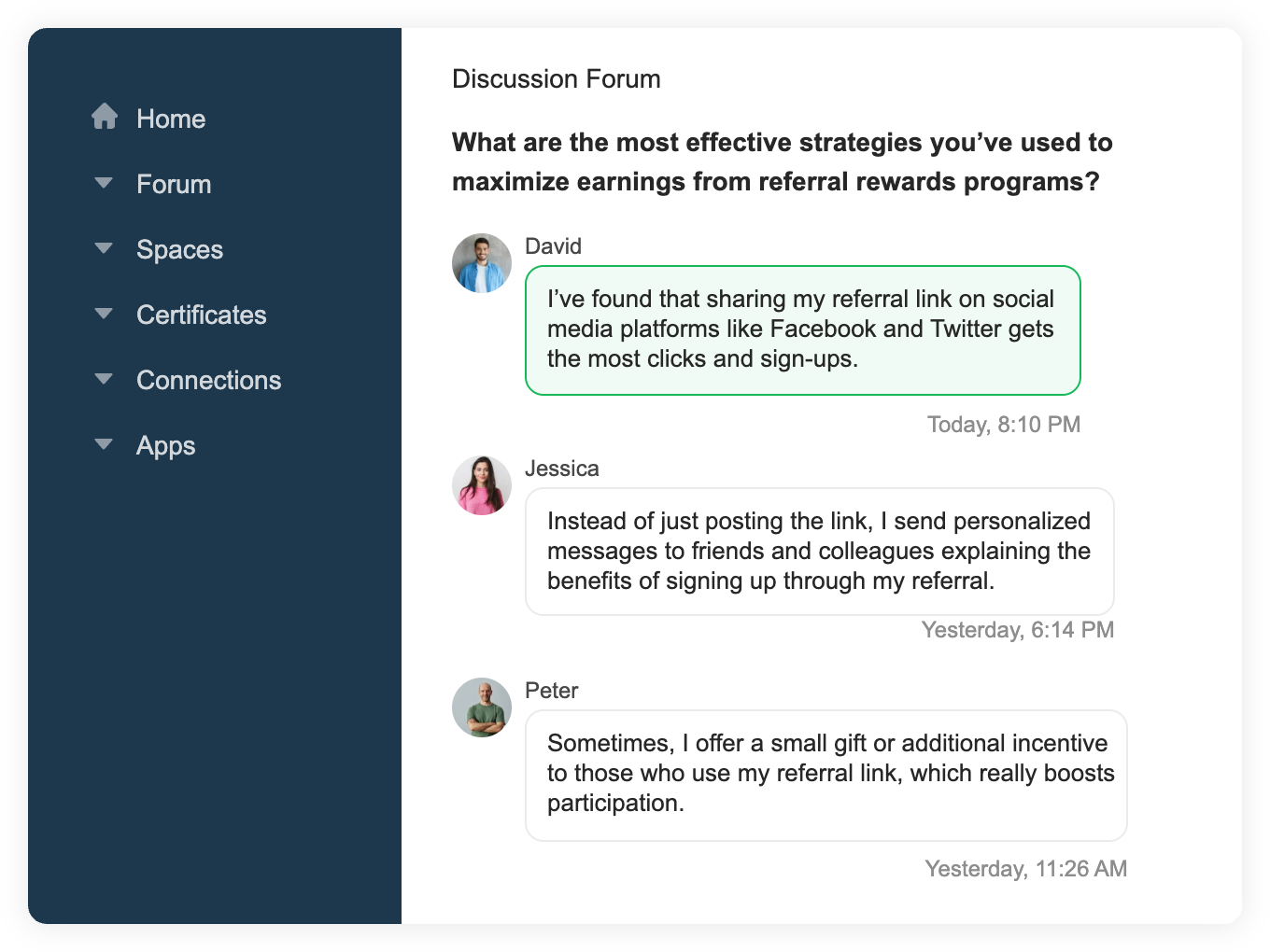
Stage 1: SSO identity verification -> Stage 2: Automated forum moderation -> Stage 3: Bidirectional CRM event sync If marketing cannot fill those lines by Tuesday, the Friday send is theater. Finish the brief. Then issue the community platform RFP.
The member type changes the questions. Customer support communities need helpdesk join and a public archive. Partner communities need account hierarchies so a dealer’s staff do not see another dealer’s rooms. Employee communities need SSO and a content license when someone leaves. Student communities need term dates and a reset that does not rebuild the roster by hand. Write the type on line one of the brief so community vendor selection does not treat those four as the same product.
Community RFP requirements to get back in writing
Ask for an artifact with each answer: a screenshot, a workflow, or a sample export. Adjectives do not score.
- How a member gets from SSO to a gated room without a second password.
- How a thread, a DM, and a group stay searchable for moderators and private from everyone else.
- How profanity, spam, and escalation work without a person reading every post.
- How points, badges, and levels are granted, and who can reverse them.
- How an event, a course, or a certificate is issued from the same member record.
- How a member record leaves with you if the contract ends.
- How price is quoted: monthly active users, feature tier, or something else. Admin seats should not be the unit if that is not how you work.
Those seven lines are the community platform scope of work. A bidder that answers only “we have forums and gamification” has not answered.
Invite or hold
Invite first
When structuring your technical evaluation criteria, pair our branded community builder architecture with the procurement scoring methodology in our community platform procurement selection guide so your evaluation committee grades each bidder on verifiable production capabilities.
A product that holds identity, rooms, moderation logs, and rewards on one member. Can show SSO on a demo. Can name the export. Can quote on members, not on a mystery scope call.
That vendor starts community vendor selection. Everyone else is scored against that showing.
Hold for a later round
A forum plugin that needs three other tools to moderate and pay. An agency that “has a portal.” A social scheduler. A brand ambassador platform that can recruit advocates but does not host the community those advocates live in.
Useful later. Not the first name on this community platform invite list.
Which vendor to start with is the invite strip, not the hold strip. Start with one name that clears invite. Add two that can beat it on a stated gap: events, courses, or data residency. Stop at four in the first round.
The Friday send
Before the community platform RFP leaves, procurement checks four boxes.
- The brief is attached, not promised.
- Each lane has an owner.
- The first vendor is an invite, not a hold.
- The pilot line is in the paper: window, KPI, and data exit. Use the same logic as our note on how to de-risk a martech buy with a pilot.
If a stakeholder adds a name after Thursday, they add it against the invite strip. They do not add it against a preference.
Three Friday mistakes show up every cycle. The packet goes out with no trust-and-safety owner. The first name is an agency because someone already has a statement of work. The pilot line is missing, so the win becomes a three-year seat. Any one of those is a reason to hold the send one week. A late community platform RFP that can be scored beats an on-time packet that cannot.
Invite us to the RFP
If Friday’s list still has no community baseline, put NextBee on it.
NextBee runs a branded community with discussions, private rooms, moderation logs, rewards, events, and courses on one member record. SSO and APIs are part of the implementation. Pricing is quoted on monthly active users, not on admin seats. Security follows SOC 2, GDPR, and CCPA, with data residency where you need it.
FAQ
What should a community platform RFP include?
The member brief, the seven requirements above, security and residency, commercial unit, and a demo on your roster type. Keep agency labor on a separate sheet.
Which vendor should we start with?
The first name that matches the invite strip. That name sets the baseline for community vendor selection.
Can an ambassador tool stand in for community?
Not as the first invite. Ambassadors need a place to work. Community is that place. Score them as two jobs if you need both.
When do we hold the send?
When the brief is blank, when trust and safety has no owner, or when every name on the draft list sits in the hold strip.
Procurement Questions and Technical Evaluation Playbooks for Your Community Platform RFP
Use this weighted technical scorecard, 90-day onboarding timeline, and data governance checklist to verify every community platform bidder before awarding your contract.
01. What technical architecture disclosures should you require from community platform RFP bidders?
Require every shortlisted bidder to submit documented SAML 2.0 and OIDC single sign-on schemas, webhook event payload samples, and role-based moderation queue latency benchmarks under 250 milliseconds. Mandate sandbox access during technical scoring so your engineering team can validate bidirectional CRM synchronization before signing a multi-year contract.
Community Platform Technical RFP Scoring MatrixWe provide your procurement and engineering teams with a weighted technical scorecard so you can audit identity federation, API throughput, and moderation automation across every community bidder.
Evaluation Domain Weighting Minimum Passing Proof Disqualification Trigger SSO and Identity Federation 35% of score Live SAML 2.0 and OIDC token exchange in sandbox Custom middleware required for basic login sync Automated Moderation Queues 35% of score Configurable keyword, sentiment, and escalation rules Manual-only post review with no audit trail Bidirectional CRM Webhooks 30% of score Real-time event payloads with automatic retry queues Batch CSV exports or delayed overnight syncs Scoring weights reflect baseline enterprise evaluation criteria and are not a forecast of vendor contract pricing; final technical pass thresholds must be supplied by your security and architecture leads. branded community and customer insight platform →02. How do you verify a vendor’s 90-day community launch timeline during the RFP process?
Demand a milestone-gated implementation schedule that separates SSO provisioning, taxonomy configuration, legacy thread migration, and moderator training into weekly sign-off deliverables. Tie 20% to 30% of implementation fees to on-time completion of user acceptance testing so your brand avoids unbudgeted launch delays.
90-Day Community Platform Onboarding Milestone CadenceOur onboarding team structures your community rollout around four verifiable delivery gates so your IT and customer success leads can track readiness from kickoff to go-live.
Step 01 · Weeks 1 to 3 · IT LeadIdentity and Taxonomy LockConfigure SAML 2.0 SSO, member permission groups, and discussion board hierarchy.Step 02 · Weeks 4 to 6 · Systems ArchitectCRM and Webhook IntegrationMap community activity events to your CRM contact records and support ticketing queues.Step 03 · Weeks 7 to 9 · Data EngineerLegacy Content MigrationImport historical forum threads, badge histories, and member reputation scores into staging.Step 04 · Weeks 10 to 12 · Community ManagerModerator UAT and LaunchComplete escalation drills, seed initial discussion prompts, and open member access.Milestone durations represent our standard deployment cadence rather than promise a fixed calendar date, as legacy database formatting and SSO approval queues are supplied by your internal IT teams. enterprise customer community implementation playbook →03. What security, privacy, and data ownership clauses belong in your community platform RFP?
Mandate SOC 2 Type II audit reports, field-level PII encryption at rest and in transit, automated GDPR and CCPA right-to-erasure workflows, and contractual confirmation that your brand retains 100% ownership of all member profiles and user-generated content with zero-fee export rights at termination.
Community Data Governance and Security RFP Audit ChecklistWe equip your legal and infosec reviewers with four mandatory governance checks to verify data sovereignty, privacy compliance, and audit logging before contract award.
- SOC 2 Type II and EncryptionVerify annual third-party security attestation plus TLS 1.3 and AES-256 encryption across all member databases.
- Automated Privacy ErasureConfirm self-service and API-driven anonymization of member PII within 72 hours of a verified deletion request.
- Role-Based Moderator LogsRequire immutable, timestamped audit trails for every post edit, thread lock, or member suspension action.
- Unrestricted Data PortabilityEnsure contractual ownership of all member records and forum threads with full JSON or CSV export upon exit.
This checklist outlines our platform security controls and does not establish legal counsel; your corporate compliance team must validate specific regulatory clauses under those assumptions. secure branded community governance framework →