
When a subscriber leaves, the first question is why. Sometimes they choose to go. Other times, a card expired, and nobody noticed. That second case is involuntary churn, and it is easy to miss because no one ever decided to cancel.
Both types land in the same churn number. However, they have different causes, different owners, and different fixes. In this guide, we explain how to tell them apart and what drives each one. Then we cover the fixes that work for both.
Voluntary vs. Involuntary Churn at a Glance
Voluntary churn
The subscriber decides to leave.
Triggers: low perceived value, price, poor fit, a change in needs
Warning signs: falling usage, support tickets, pricing page visits
Usual owners: marketing, product and customer success
Main fixes: onboarding, engagement, loyalty rewards, save offers
Involuntary churn
No one decides. A payment fails.
Triggers: expired or replaced cards, declines, outdated details
Warning signs: upcoming expiry dates, soft declines, bounced invoices
Usual owners: billing, finance and payments teams
Main fixes: reminders, smart retries, card updates, grace periods
The good news is that both types leave signals in data you already have. A subscriber retention platform connected to your billing and usage data can flag both kinds of risk. It can then respond automatically, before the subscription ends.
What Is Involuntary Churn?
Involuntary churn happens when a subscription ends because a payment fails, not because the subscriber chose to cancel. Many teams also call it passive churn. The subscriber may still like your product. They simply stopped paying without meaning to.
One note on terms. In older telecom analysis, “involuntary churn” often meant losses from events like a customer moving away. Those cases were usually excluded from churn models. In subscription businesses today, the term almost always refers to payment failure, and we use it that way here.
These are the most common causes:
Cause What happens Expired cards The card on file passes its expiry date and the next charge is declined. Replaced cards A bank reissues a card after loss, theft or a data breach, and the old number stops working. Insufficient funds The account balance or credit limit cannot cover the charge on billing day. Issuer blocks The bank flags a recurring charge as unusual and declines it. Outdated account details A billing address, bank account or invoice contact is no longer valid. Technical errors A gateway timeout or a misconfigured retry rule stops a payment that would have cleared. What Is Voluntary Churn?
Voluntary churn is a deliberate cancellation. The subscriber weighed what they pay against what they get, and decided to leave. Because it reflects a choice, it usually points to something you can improve.
The reasons tend to fall into a few groups:
- Value gap. The subscriber never reached the result they signed up for, often because onboarding stalled.
- Price. The cost feels high for how often they use the product, or a price increase changed the math.
- Poor fit. Your marketing attracted people whose needs your product does not fully meet.
- Experience issues. Slow support, delivery problems or bugs wear down goodwill over time.
- Life changes. A move, a new job or a tighter budget changes what they need.
How to Tell Which Type of Churn You Have
You cannot fix what you do not measure separately. So start by tagging every lost subscriber with a reason at the source. Your billing system knows when a subscription ended after failed payments. Your cancellation flow can capture the reason when someone cancels on purpose.
Then calculate each rate on its own, using the same starting number:
Churn split formula
Involuntary churn rate = (Subscribers lost to failed payments ÷ Subscribers at the start of the period) × 100
Voluntary churn rate = (Subscribers who cancelled ÷ Subscribers at the start of the period) × 100
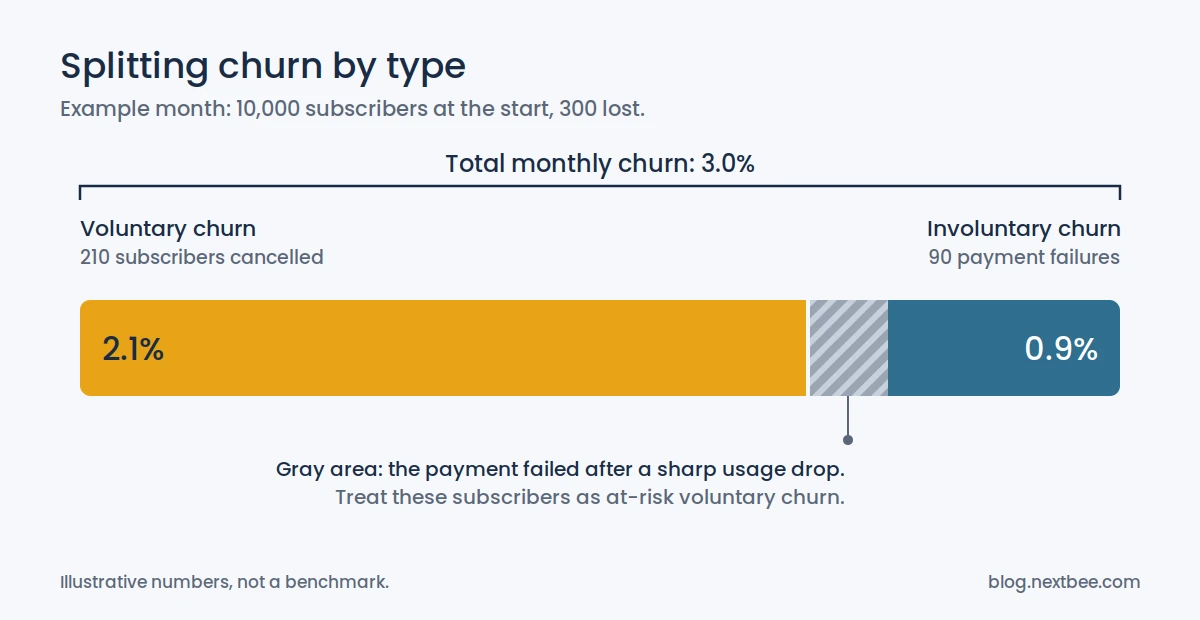
For example, say you start the month with 10,000 subscribers and lose 300. If 90 of those were payment failures, your involuntary churn rate is 0.9%, and your voluntary churn rate is 2.1%. In that case, 30% of your churn is involuntary.
*These are illustrative numbers, not a benchmark.
Watch for one gray area. Some subscribers let a failed payment go because they were planning to leave anyway. On paper, they look like involuntary churn. In practice, they chose to go.
A simple way to catch them is to check usage. If a subscriber’s activity dropped sharply in the weeks before the payment failed, tag them as at-risk voluntary churn. Otherwise, your payment fixes will look weaker than they are. Your engagement problem will also look smaller than it is.
Soft Declines vs. Hard Declines
Not every failed payment is the same. How you respond depends on the type of decline the bank sends back.
Decline type Common examples What to do Soft decline Insufficient funds, temporary issuer problem, activity limit reached Retry later, spaced out over days, while prompting the subscriber Hard decline Closed account, lost or stolen card, invalid card number Do not retry. Ask the subscriber for a new payment method 
Card networks limit how often you can retry
Retrying every decline over and over can cost you money. Under Visa’s Excessive Reattempts Rule, merchants can be charged fees for retrying a transaction in the “never retry” category. Fees can also apply after a set number of reattempts within 30 days. Mastercard runs a similar program built around its Merchant Advice Codes.
* Exact limits differ by network and are updated from time to time. Confirm the current rules with your payment processor before you set your retry schedule.
How to Fix Involuntary Churn
Involuntary churn is often the faster type to improve, because the subscriber never meant to leave. These steps build on each other, so work through them in order.
1Keep card details current automatically
Card networks offer account updater services that pass new card numbers and expiry dates to merchants when a bank reissues a card. Ask your payment processor whether these are switched on for your account. Network tokens, where available, can also keep stored credentials valid after a card is replaced.
2Retry by decline type, not on a fixed loop
Retry soft declines at spaced intervals, and stop hard declines right away. Try different days and times, since a charge that fails on one day may clear a few days later. Stay inside the network limits above.
3Warn subscribers before the card expires
You know expiry dates in advance, so use them. Send a short reminder a few weeks ahead and another closer to the date. That gives subscribers time to update before anything fails.
4Make updating payment details effortless
Send a secure, one-tap link that opens a mobile-friendly payment form. Every extra step, like a forgotten password, costs you recoveries.
5Keep access open during a grace period
Cutting off access on the first failure turns a billing hiccup into a cancellation. A short grace period keeps the relationship intact while the subscriber fixes the problem.
6Use the right tone and channel
Write payment messages as help, not warnings. Then reach subscribers where they respond, whether that is email, SMS, push, or an in-app banner.
7Reward good payment habits
Give bonus points or a small credit when subscribers enroll in auto-pay, add a backup payment method or update an expiring card early. That way, prevention becomes something subscribers want to do.
How to Fix Voluntary Churn
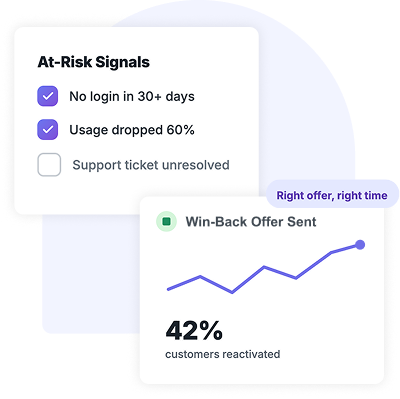
Voluntary churn takes longer to move, because you are changing how subscribers feel about your product. On the other hand, the gains compound, since every improvement helps future subscribers too.
Close the value gap early
Define the first moment of real value for your product, and build onboarding that gets new subscribers there fast.
Make value visible
Send regular recaps of what subscribers used, saved or achieved, so the benefit is clear before each charge.
Reward staying
Tenure tiers, renewal bonuses and usage rewards make each month of membership worth more than the last.
Offer flexibility
Pause, skip and downgrade options keep subscribers who need a change, not an exit.
Match save offers to reasons
Show a price offer to price-sensitive subscribers and a pause to busy ones, with a clear cancel option on the same screen.
Win them back later
Reach former subscribers with what is new, timed to the reason they left.
For the full stage-by-stage playbook, including cancellation flow rules, see our guide on how to reduce subscription churn.
Where Voluntary and Involuntary Churn Overlap
The two types are separate in reporting, but they often connect in real life. Here are three places to use one to help the other:
- Expiry reminders as value moments. A card update request is also a chance to show what the subscriber has gained. Add a short usage recap or a points balance to the message.
- Failed payments as engagement signals. A subscriber who ignores several payment reminders may be quietly deciding to leave. Route them to an engagement or save play, not just more billing emails.
- Payment churners as win-back targets. People who left because of a failed payment never chose to go. That makes them strong candidates for a welcome-back offer. Win-back campaign software can reach them automatically with their history and preferences intact.
How Churn Types Differ by Business Model
The split between voluntary and involuntary churn shifts with how you bill and who you bill.
Business model What to watch Streaming and digital media Low monthly prices make card failures easy for subscribers to ignore, so proactive card updates matter. Subscription boxes and DTC Skips and pauses often come before voluntary churn. Failed charges delay shipments, which adds a service problem on top. B2B software The card on file may belong to an employee who left. Expired purchase orders and invoices sent to old contacts cause failures too. Memberships and associations Annual dues put most of the risk on one renewal date. Reminders and payment checks before it carry extra weight. Financial services Premium accounts and paid card memberships face both types. Banks and credit unions can use a financial services marketing platform to tie renewals and rewards to account activity. Metrics to Track for Involuntary Churn and Voluntary Churn
Give each type its own scorecard. These metrics show whether your fixes are working:
Involuntary churn scorecard
- Payment failure rate
- Recovery rate on failed payments
- Average days to recover a payment
- Involuntary churn rate by cohort
Voluntary churn scorecard
- Voluntary churn rate by cohort
- Save rate by cancellation reason
- Time to first value for new subscribers
- Reactivation rate of former subscribers
Review both each month, side by side. If total churn falls but one type rises, you will see it early.
Tackle both types of churn with NextBee
At NextBee, we help subscription businesses act on both kinds of churn from one platform. We connect to your billing platform and CRM and flag at-risk subscribers. Then we run reminders, rewards, save offers, and win-back campaigns across email, SMS, push, and in-app.
Our platform is built on SOC 2 Type II, GDPR, and CCPA standards. Most subscription programs go live in two to four weeks.
Frequently Asked Questions
Is involuntary churn the same as passive churn?
Usually, yes. Most subscription teams use the two terms for payment-failure churn. Some teams, however, use passive churn for subscribers who still pay but no longer use the product. Pick one definition and use it consistently in your reports.
How much of total churn is usually involuntary churn?
It varies widely with your payment mix, region, price point and customer type, and published estimates differ a lot. Your own split, tracked by cohort, is the number that matters. Once you tag every loss by reason, you will know within one or two billing cycles.
When should a failed payment count as churn?
Most teams count it at the end of the grace or recovery period, not on the first failed charge. Otherwise, your churn rate swings with every retry. Whatever rule you choose, apply it the same way every month.
Can loyalty programs reduce involuntary churn?
Yes, indirectly. Rewards for enrolling in auto-pay, adding a backup card or updating details early prevent failures before they happen. A points balance or tier status also gives subscribers a reason to fix a failed payment quickly.
Who should own involuntary churn?
It works best as a shared goal. Billing or finance runs retries and updater services. Marketing owns the reminder messages and rewards, and customer success steps in for high-value accounts.