
Most subscribers don’t cancel on the day they click the button. They drift first. Logins slow down, a box gets skipped, or a payment fails, and nobody follows up. Teams that reduce subscription churn consistently know this, so they work across the whole subscriber lifecycle.

By the time a cancellation arrives, the decision was usually made weeks earlier. The cancellation page is only the last stop.
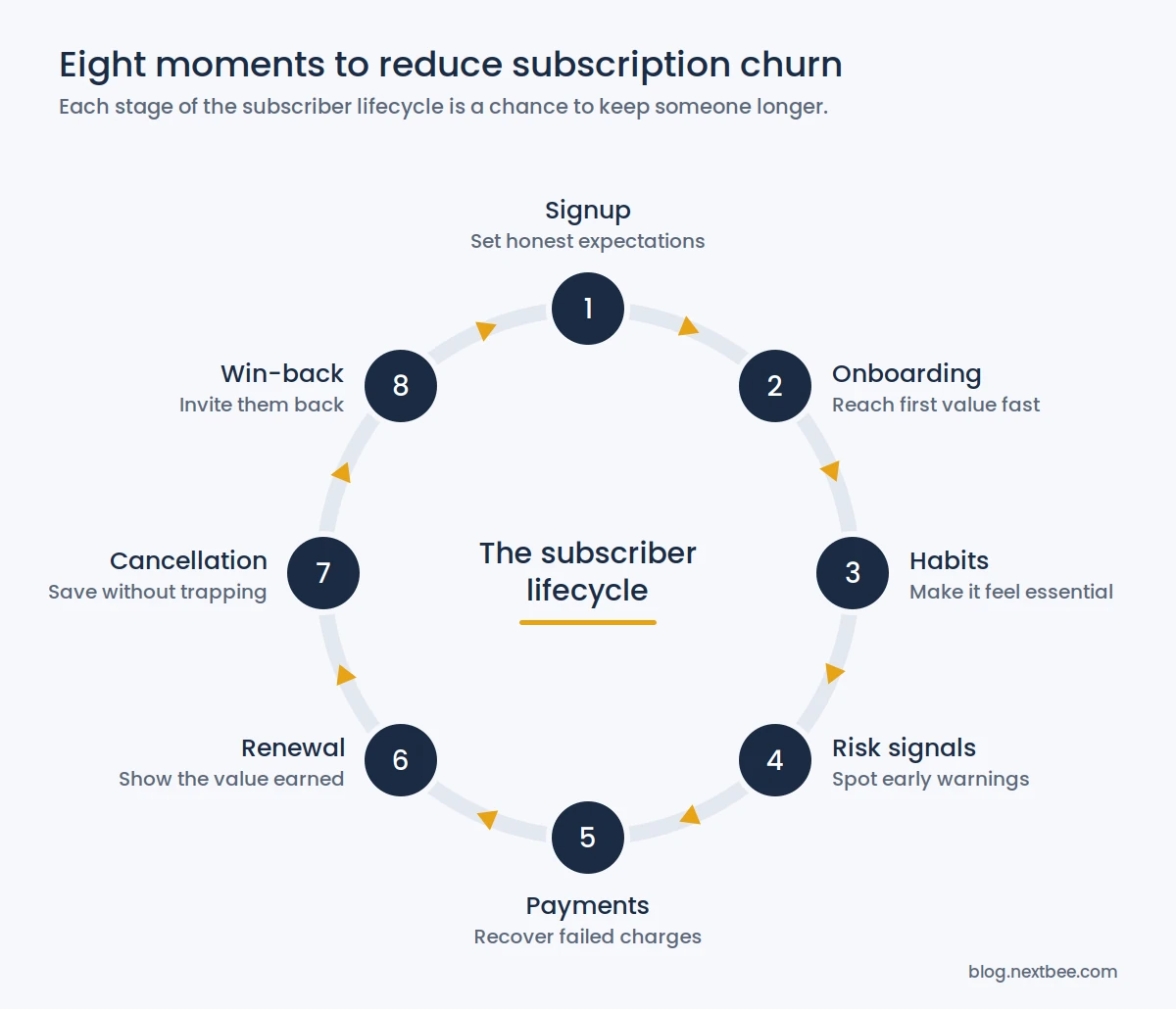
In this guide, we walk through eight stages where subscribers decide to stay or leave, from signup to win-back. For each stage, you get the signals to watch and the tactics that work. We also cover the cancellation rules that now shape how save offers can be shown.
Key takeaways
- Churn starts long before cancellation. Usage drops, skipped orders and failed payments are early signals you can act on.
- Voluntary and involuntary churn have different causes, so they need different fixes.
- Strong onboarding and daily habits protect more revenue than last-minute discounts.
- Rewarding tenure and usage makes staying more valuable each month.
- Save offers still work, but cancellation must stay easy. California now requires a visible cancel option next to any online save offer.
- Measure churn by cohort and by reason, so you know which tactic moved the number.
In this guide
- Why it is hard to reduce subscription churn
- Set honest expectations at signup
- Get new subscribers to first value fast
- Build habits that make the subscription feel essential
- Where loyalty programs help
- Spot at-risk subscribers before they decide
- Recover failed payments
- Make renewal moments work for you
- Design a cancellation flow that saves without trapping
- Win back subscribers who leave
- Metrics to track
- A simple plan for this quarter
- Frequently asked questions
Why It Is Hard to Reduce Subscription Churn
Churn is hard to fix because it shows up as one number with many causes behind it. A monthly churn rate of 4% can hide a loyal core of long-term subscribers and a leaky group of new ones who never got started.
So start by splitting churn into two types:
- Voluntary churn happens when the subscriber chooses to leave. Common reasons include low perceived value, price, a change in needs or a better alternative.
- Involuntary churn happens without a decision. Expired cards, insufficient funds, and bank declines are the usual causes.
Churn type What usually causes it Where to fix it Voluntary Value gaps, price, poor fit, low usage Onboarding, engagement, renewal offers, cancellation flow Involuntary Failed, expired or declined payments Payment reminders, retries, easy card updates, grace periods Next, calculate churn the same way every time. The standard formula is the number of subscribers lost during a period, divided by the number at the start of that period, multiplied by 100.
Churn rate formula
(Subscribers lost during the period ÷ Subscribers at the start of the period) × 100
For example, say you start the month with 10,000 subscribers and 400 cancel. Your monthly churn rate is 4%. These are illustrative numbers, not a benchmark.
Finally, break that rate down by cohort: signup month, plan, acquisition channel and region. A blended rate tells you there is a problem. Cohort churn tells you where it is.
Stage 1: Set Honest Expectations at Signup
Some churn is built in at checkout. When subscribers expect one thing and receive another, no later tactic fully repairs the gap.
Here is how to close it early:
- Match the promises in your ads and landing pages to what the first month actually delivers.
- Show the full price after any promotional period, plus the billing frequency, before checkout.
- Tell new subscribers what happens next and when, such as their first delivery, first login or first result.
- Ask one or two quick questions at signup, like their main goal or a product preference. This data helps you personalize from day one.
Clear terms also carry legal weight. California’s amended auto-renewal law now requires express affirmative consent to renewal terms. The change applies to contracts entered into, amended or extended on or after July 1, 2025.
Stage 2: Get New Subscribers to First Value Fast
For most subscription businesses, the first few weeks carry the most risk. The subscriber has paid but has not yet seen the payoff. Your goal is to shorten the time between payment and the moment they think, “this was worth it.”
First, define that moment for your product. For a streaming service, it might be finishing a first series. For a meal kit, it could be cooking the second box. For B2B software, it is often the first report a user shares with their manager.
Then build onboarding around reaching it:
- Break setup into three to five steps with a visible progress bar.
- Reward each completed step with something useful, like bonus content, a credit on the next order or points toward a first reward. With subscription loyalty software, these rewards trigger automatically from signup and usage events.
- Send messages based on behavior, not the calendar. A subscriber who finished setup on day one needs a different email than one who has not logged in yet.
- Reach customers and partners on the channel they respond to. For app-first products, in-app prompts and push notifications often land better than email. A mobile app engagement platform lets you run these journeys inside the app itself.
Stage 3: Build Habits That Make the Subscription Feel Essential
Subscribers who use a product often rarely question the charge. On the other hand, those who use it now and then review it every billing cycle.

Governance ledger tracking subscriber onboarding milestones, usage drop-off triggers, and cancel-flow save rules. Building on the subscriber retention architecture shown above, our platform connects your billing signals and usage drop-offs directly to targeted save offers.
These habit builders work across most subscription models:
- Streaks reward steady use, like daily reading, weekly workouts, or monthly reorders.
- Challenges point subscribers toward features they have not tried.
- Personalized recommendations draw on what each subscriber has used or bought before.
- Progress summaries show the value delivered, such as articles read, hours saved or shipping costs avoided.
One caution here. Rewarding logins alone can inflate activity without changing outcomes. Instead, reward the specific actions your data links to long-term subscribers.
Where Loyalty Programs Help Reduce Subscription Churn
A loyalty layer gives subscribers a reason to stay that grows over time. The longer they stay, the more they lose by leaving.
These mechanics fit subscription businesses well:
- Tenure tiers unlock better perks at milestones like 6, 12, and 24 months.
- Renewal rewards add bonus points, extended access or a free add-on when a subscriber renews on time.
- Usage rewards give points for the actions that predict retention.
- Referral rewards credit both the subscriber and the friend they bring in. As a result, new subscribers arrive with context from someone they trust.
How this can look in practice
- A digital publisher might offer an ad-free day after a seven-day reading streak.
- A professional association could give a free conference pass at five years of membership.
- A B2B software company might upgrade an account admin’s tier each time their team adds seats.

Stage 4: Spot At-Risk Subscribers Before They Decide
Churn rarely comes without warning. The trick is to watch the right signals and respond while the subscription is still active.
Signal What it may mean A helpful response Usage drops below the subscriber’s own baseline Losing interest or stuck on a problem A useful tip, content pick or check-in Skipped or paused orders Too much product or budget pressure Change frequency or offer a smaller plan Open support tickets Frustration building Priority follow-up from a person Visits to the pricing or downgrade page Price sensitivity A right-sized plan offer Failed payment Involuntary churn risk A quick payment update flow Low seat usage in a B2B account Weak adoption Customer success outreach or training Combine a few of these into a simple risk score. Start with three or four signals you trust, then refine the weights as you learn. Route high-value accounts to a person and automate the rest.
To intervene before at-risk subscribers click cancel, pair our personalized smart retention offers with our diagnostic breakdown on fixing voluntary and involuntary subscriber churn so your retention team addresses both billing failures and product fatigue.
This is where customer retention software earns its place. It watches these signals across your data and triggers the right save play at the right time.
Stage 5: Recover Failed Payments Before They Become Churn
Involuntary churn is often the easiest type to reduce, because the subscriber never meant to leave. Still, it needs a clear process:
- Remind subscribers before their card expires.
- Retry failed payments on a schedule instead of just once.
- Send a one-tap link to update payment details, without a login wall.
- Offer a short grace period, so access continues while they fix it.
- Keep the tone helpful. “Your payment didn’t go through” reads as support, while a stern warning reads as a threat.
You can also reward subscribers for enrolling in auto-pay or adding a backup payment method. That way, you prevent the problem before it starts.
Stage 6: Make Renewal Moments Work for You
Renewal is when subscribers reconsider the purchase, especially on annual plans. Treat it as a moment to remind them of the value, not just to collect payment.
- Send a value recap before renewal that shows what they used, saved or earned.
- Offer an incentive for renewing early or for moving from a monthly to an annual plan.
- Remind them of perks they have not used yet.
- Tell them about any price change early and plainly.
Some of this is now required. Under California’s updated law, you must give notice of a fee increase at least 7 and no more than 30 days before it takes effect. You must also send an annual reminder that covers the charges and how to cancel.
Stage 7: Design a Cancellation Flow That Saves Without Trapping
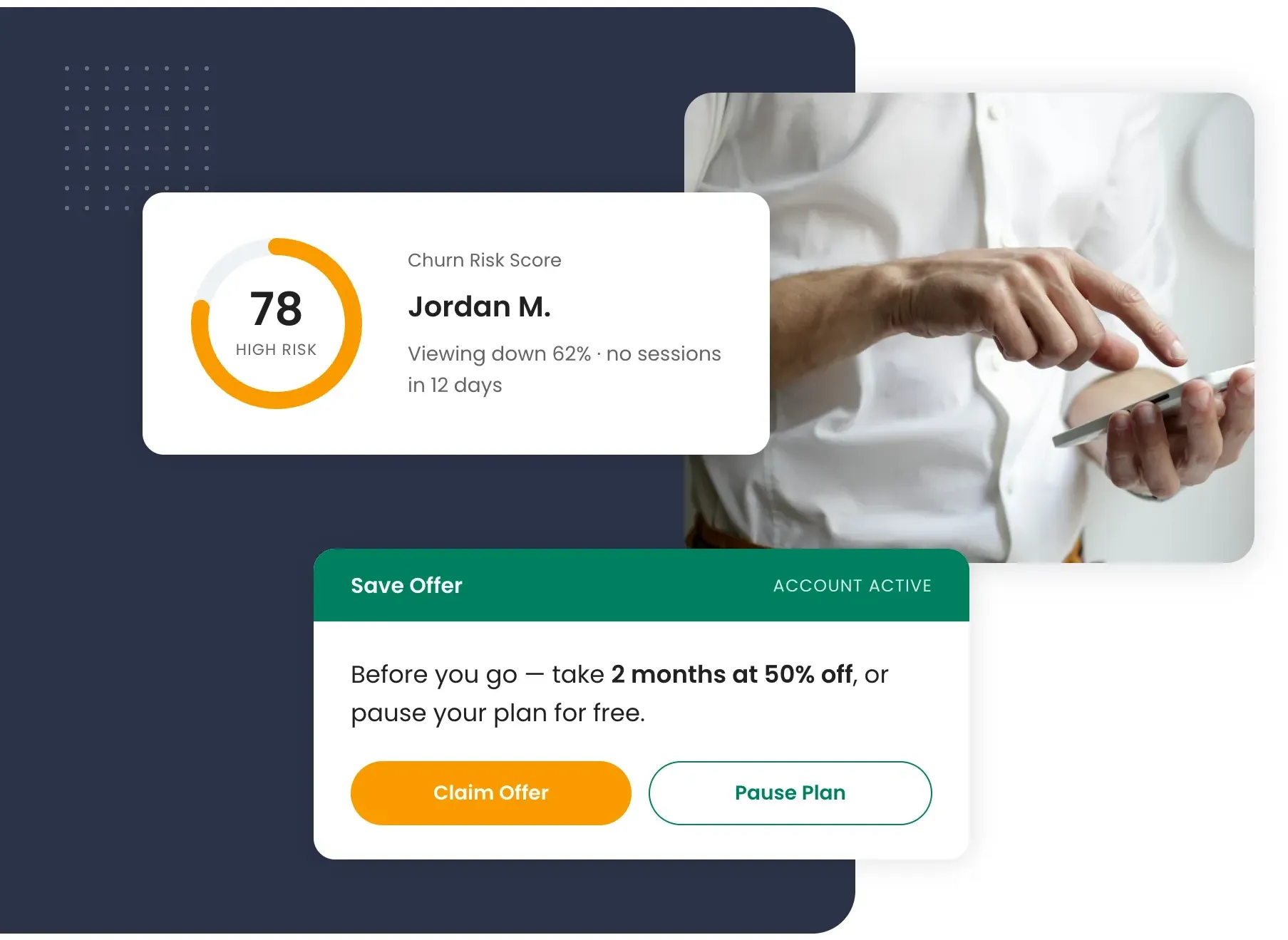
A good cancellation flow gives departing subscribers one real reason to reconsider, and a clear exit if they still want to go.
The key is matching the offer to the reason they give:
Reason for leaving Offer that fits Too expensive A lower tier or a limited-time discount Not using it enough A pause or a lower frequency Too much product Skip, swap, or a smaller box Missing a feature A different plan, a roadmap update or a support session Temporary situation, like travel Pause and resume on a set date Keep the offers to a single screen, and always record the reason. Over time, those reasons become your best source of product and pricing insight.
The rules around cancellation have shifted
On July 8, 2025, the Eighth Circuit vacated the FTC’s click-to-cancel rule because of procedural problems in how it was issued. However, the FTC restarted the process in March 2026 by asking for public comment on its Negative Option Rule. It also continues to enforce the Restore Online Shoppers’ Confidence Act.
At the state level, California sets a high bar. If subscribers can sign up online, they must be able to cancel online. A business may show a save offer during cancellation, but it must display a prominent click-to-cancel button at the same time.
You can read the full California bill text and a summary of the FTC’s new rulemaking.
- Because rules vary by state and change often, review your flow with legal counsel. This section is general information, not legal advice.
Stage 8: Win Back Subscribers Who Leave
Former subscribers already know your product, and many left for reasons you can address. That makes them one of your most promising audiences.
- Time your outreach to the reason they left, such as a seasonal pause or a tight budget.
- Lead with what is new or improved since they canceled.
- Personalize with their history, like a favorite category or most-used feature.
- Make coming back easy, with saved preferences and restored benefits.
- Stop after a few attempts, and respect every opt-out.
Holding a former subscriber’s points balance or tier status for a set period also helps. It gives them something concrete to return to.
Metrics to Track as You Reduce Subscription Churn
Each tactic above needs a number that shows whether it worked. These are the ones we recommend tracking:
Metric What it tells you Monthly churn rate by cohort Where churn is concentrated Voluntary and involuntary split Which playbook needs attention Payment recovery rate How well your failed-payment flow performs Save rate by cancellation reason Which offers keep subscribers Time to first value How healthy your onboarding is Net revenue retention Whether upgrades offset lost revenue Reactivation rate How well your win-back campaigns work Test each new tactic against a holdout group that does not receive it. That way, you know the change came from the tactic and not from seasonality.
A Simple Plan to Reduce Subscription Churn This Quarter
You don’t need to launch all eight stages at once. Use your cohort data to find the stage where most subscribers leave, and start there with one or two tactics. Run them for at least one full billing cycle, measure the result, and then add the next.
For larger teams, the biggest gains come from connecting systems. When billing, CRM and product usage data feed the same rules, rewards and messages respond to what subscribers actually do.
Put this playbook to work with NextBee
At NextBee, we help subscription businesses put this into practice. Our platform runs renewal incentives, tenure tiers, churn risk alerts, save offers and win-back campaigns across email, SMS, push and in-app. It connects to your billing platform and CRM, and it is built on SOC 2 Type II, GDPR and CCPA standards.
Most subscription programs go live in two to four weeks.
Frequently Asked Questions
What is a good subscription churn rate?
It depends on your industry, price point, contract length and whether you sell to consumers or businesses. Annual contracts usually churn less than monthly plans, and B2B accounts behave differently from consumer subscriptions. The most useful benchmark is your own trend by cohort. If each new cohort retains better than the last, your tactics are working.
What is the fastest way to reduce subscription churn?
Start with involuntary churn. Card expiry reminders, payment retries and one-tap card updates are quick to set up. They also recover subscribers who never intended to leave.
How can you reduce subscription churn without discounting?
Focus on value before price. Faster onboarding, habit-building challenges, tenure perks and a pause option all keep subscribers without cutting your margin. Keep discounts for cases where price is the stated reason for leaving.
Should you make cancellation harder to keep subscribers?
No. Hard-to-find cancellation paths frustrate subscribers and create legal risk under state auto-renewal laws. A clear exit, paired with one relevant save offer, protects both trust and compliance.
How do loyalty programs lower subscription churn?
Subscription Retention, Cancel-Flow, and Win-Back Playbooks
Use these governance matrices, decision rules, and benchmark models to configure and audit your program workflows.
What subscription box retention tactics prevent third-month cancellation spikes?
Trigger a skip-a-month or cadence-swap option seven days before the third billing cycle while releasing a milestone loyalty gift on the fourth consecutive shipment. Giving overstocked subscribers a one-click pause or product swap deflects 22% to 35% of voluntary third-month cancellations without eroding your average order margin.
Subscription Box Pre-Bill Intervention Decision EngineWe automate pre-bill inventory checks and milestone reward prompts so your subscribers adjust delivery frequency instead of canceling their recurring plan.
Day 21 First-Box Feedback Check Trigger a 2-question flavor or fit survey 7 days after first delivery to auto-update second-month SKU preferences. Cycle 3 Overstock Risk Gate - Detect subscribers who have not logged into their portal or rated items for 45 days.
- Send an SMS pre-bill reminder offering a 30-day skip or 60-day delivery cadence switch.
- Display the upcoming Cycle 4 milestone bonus gift to reinforce streak value.
Pre-Renewal Card Expiry Alert Prompt subscribers with cards expiring within 30 days to update payment details in exchange for 150 bonus points. VIP Annual Upgrade Offer Present a 15% prepay savings offer with free shipping after a subscriber completes 6 consecutive monthly renewals. Retention save rates operate under those assumptions configured in your billing gateway and do not predict future subscriber lifetime value. explore our subscription box retention platform →How should online cancellation flows match save offers to exit reasons?
Map each exit survey choice in your online cancellation flow to a single targeted remedy: offer a 30-day pause for temporary budget or travel reasons, a guided onboarding call for low feature adoption, and a downgraded tier for price sensitivity. Dynamic exit routing saves 15% to 28% of canceling accounts while complying with one-click cancellation rules.
Cancel-Flow Save Routing and Cooldown TimelineOur cancel-flow engine pairs exit-reason branching with strict 180-day discount cooldowns so your brand saves high-LTV subscribers without training discount hunters.
Step 01 · Instant · Cancel ModalStep 1: Exit Reason CapturePresent 4 clear exit reasons alongside a visible direct-cancel button for full FTC compliance.Step 02 · Under 200ms · Rules EngineStep 2: Eligibility and Cooldown CheckVerify account tenure and suppress monetary discounts if the subscriber claimed a save offer within 180 days.Step 03 · Interactive · Retention UIStep 3: Tailored Save RemedyOffer a billing pause, plan downgrade, or unredeemed loyalty points reminder matched to the exit reason.Step 04 · Day 30 · Lifecycle FlowStep 4: Post-Save Health CheckConfirm the saved subscriber engages with the updated plan or trigger a customer success follow-up.Cancel-flow routing rules reflect the billing parameters supplied by your subscription platform rather than replace legal review of local auto-renewal statutes. see our cancellation flow software →How do you structure a win-back offer strategy for lapsed subscribers without hurting margin?
Segment lapsed subscribers by prior tenure and exit reason, then sequence your win-back outreach starting with product upgrade announcements at Day 14 before introducing bonus loyalty credits at Day 45. Reserving monetary incentives for formerly high-margin subscribers recovers 8% to 14% of churned accounts at half the cost of cold paid acquisition.
Lapsed Subscriber Win-Back Prioritization ScorecardWe score churned accounts by historical margin, tenure, and exit reason so your marketing budget targets former subscribers who will stay past 90 days.
Cohort Attribute Weight High-Priority Win-Back Signal Assigned Win-Back Offer Historical Net Margin and Tenure 40% 6+ paid billing cycles with zero prior chargebacks Restored VIP tier status plus $20 credit on second month Recorded Exit Survey Reason 35% Canceled due to missing feature or seasonal pause Feature release walkthrough plus 14-day free reactivation Post-Cancel Engagement Signal 25% Opened product update email or visited pricing page 48-hour bonus points multiplier upon plan reactivation Cohort weights illustrate an evaluation framework under those assumptions and do not establish a guaranteed reactivation rate. build your win-back offer strategy →They make staying more rewarding over time. Points, tier status, and tenure perks build up the longer someone subscribes, so leaving means giving something up. Rewards for renewing and referring friends add further reasons to stay.