
Gamification is the practice of applying elements from games, such as points, progress tracking, and rewards, to activities that are not games. That usually means customer purchases, employee training, sales activity, or partner engagement.
Most people have experienced gamification without calling it that. A coffee shop loyalty card that fills up one stamp at a time is gamification. A fitness app tracking a daily streak, or an onboarding checklist that shows how many steps are left, that’s gamification. These may look like simple activities. What gets added is a way to see progress and a reason to finish.
Where the Idea of Gamification Comes From
Games have relied on the same basic ideas for decades: set a goal, show progress toward it, and reward the person who reaches it. It builds activity because people want to know where they stand. A task with no feedback is easy to postpone. The same task with a visible finish line tends to get done.
Business gamification applies the same concept to something the organization wants. A completed purchase. A finished training course. A referral. A closed deal.
The action itself does not change. What changes is whether the person doing it can see their own progress, and whether that progress is acknowledged.
The Mechanics Most Gamification Programs Use
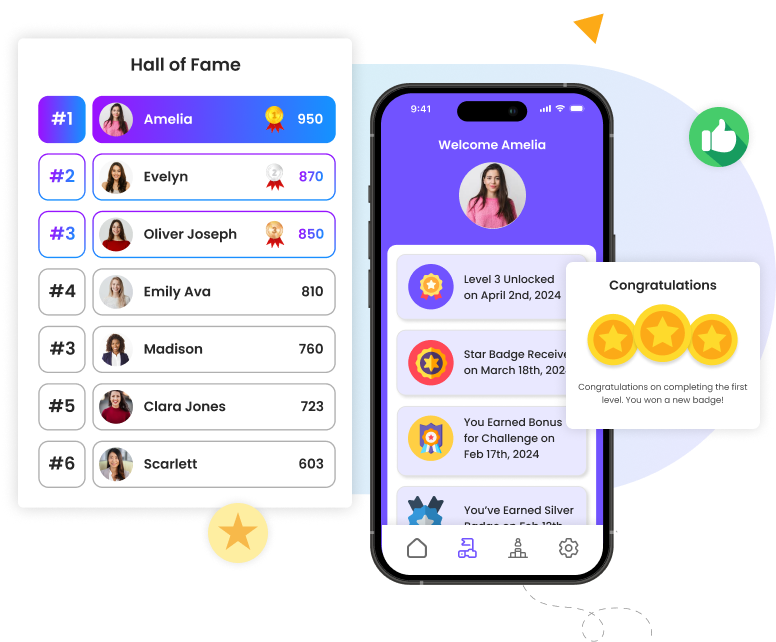
A few tools appear across nearly every program, though few use all of them at once:
- Points are the basic unit, earned for a specific action, and usually the foundation everything else builds on.
- Badges mark a one-time achievement. They work well for things that do not fit neatly into a running point total, like completing a first order or finishing a certification.
- Tiers group participants by activity level, often unlocking additional benefits at higher levels.
- Leaderboards show standing relative to others. They tend to work better in smaller or naturally competitive groups than in large, mixed audiences.
- Challenges are short tasks with a defined endpoint, unlike an open-ended goal like “engage more.”
Choosing a couple of these usually works better than using all five at once. The right combination depends more on who the audience is than on the mechanics themselves.
A Simple Example of Gamification
Consider a software company trying to get new users through setup. Without structure, the setup guide sits in an inbox, and half the people never open it.
Add a five-step checklist with a progress indicator, plus a small reward at completion, and the same task now has a visible shape. The user can see there are two steps left instead of an undefined amount of work ahead. Nothing about the setup process changed. Only the framing around it did.
Where It Shows Up
Gamification is not tied to one department.
A DTC business might use tiers and points to reward frequent buyers. A company that sells through resellers might want to gamify its partner portal or deal registrations in order to keep that channel active. Or an HR team might use badges or offer peer recognition during onboarding. A sales team might also run a leaderboard alongside standard compensation to reinforce a specific habit.
Different audiences, same underlying mechanism. Only the goal and the reward change each time.
Why Gamification Works, and Where It Does Not
The appeal is straightforward. An unstructured task is easy to ignore. Add a progress bar and a completion badge, and there is a reason to open it.
Gamification is not a fix on its own, though. A program built on one reward, offered the same way every time, can lose effectiveness. People notice repetition faster than most programs account for. The mechanics matter less than whether they are built around what the specific group actually responds to.
Starting Small
A lot of our clients don’t gamify everything at once. They pick one behavior that they want to encourage, choose mechanics that suit that goal and audience, then adjust as they learn what participants respond to. What worked at launch rarely holds up unchanged a year later.
That is the part worth planning for. A gamification platform built to accommodate ongoing changes is easier to keep current than a system designed around a fixed set of rules.