
Most fixed ops marketing advice is written from the marketing department’s chair. It covers ads, search rankings and social posts. Those matter, but a service director measures success differently: full bays on slow days, owners who return on schedule and declined work that comes back.
This guide is written from the service director’s side of the desk. It covers what automotive fixed ops marketing should achieve and how to plan around bay capacity. It also shows what to send at each stage of ownership and which numbers prove it is working.
276M+
repair orders written by U.S. franchised dealerships in 2025
$164.6B
in total service and parts sales, about $9.7 million per dealership
$494
in average service and parts sales per customer-pay repair order
Source: NADA Data 2025 annual financial profile.
What Fixed Ops Marketing Should Achieve
Good service marketing is not about volume alone. A packed Monday and an empty Thursday average out to an average week, which hides lost revenue. Fixed ops marketing has four jobs:
Fill the capacity you actually have
Push appointments into open technician hours rather than days that are already full.
Bring owners back on schedule
Remind every owner at the right mileage or interval, before another shop reaches them.
Recover declined work
Follow up on recommended repairs the customer said no to during the visit.
Keep post-warranty owners
Give owners a reason to stay once free or covered service ends.
A dealership marketing platform that reads your DMS data can run all four at once. It triggers the right message from real repair orders and vehicle records, rather than from a mailing list.
Plan Fixed Ops Marketing Around Bay Capacity
Every car dealer’s service drive has rhythms. In many stores, the start of the week fills fast while mid-week afternoons sit open. Seasonal peaks, like tire changeovers, stretch capacity even further. Your marketing calendar should follow your shop schedule, not the other way around.
When the shop is Marketing move Consistently open mid-week Offer bonus loyalty points or a small perk for booking open days Full early in the week Pause promotions and send reminders only, so you protect margin Heading into a seasonal peak Open early booking weeks before the rush and spread demand Short on technicians Promote quick services in the express lane and hold heavy repairs for open slots Coming out of a slow month Run declined-service and lapsed-customer campaigns first, since those owners already know you 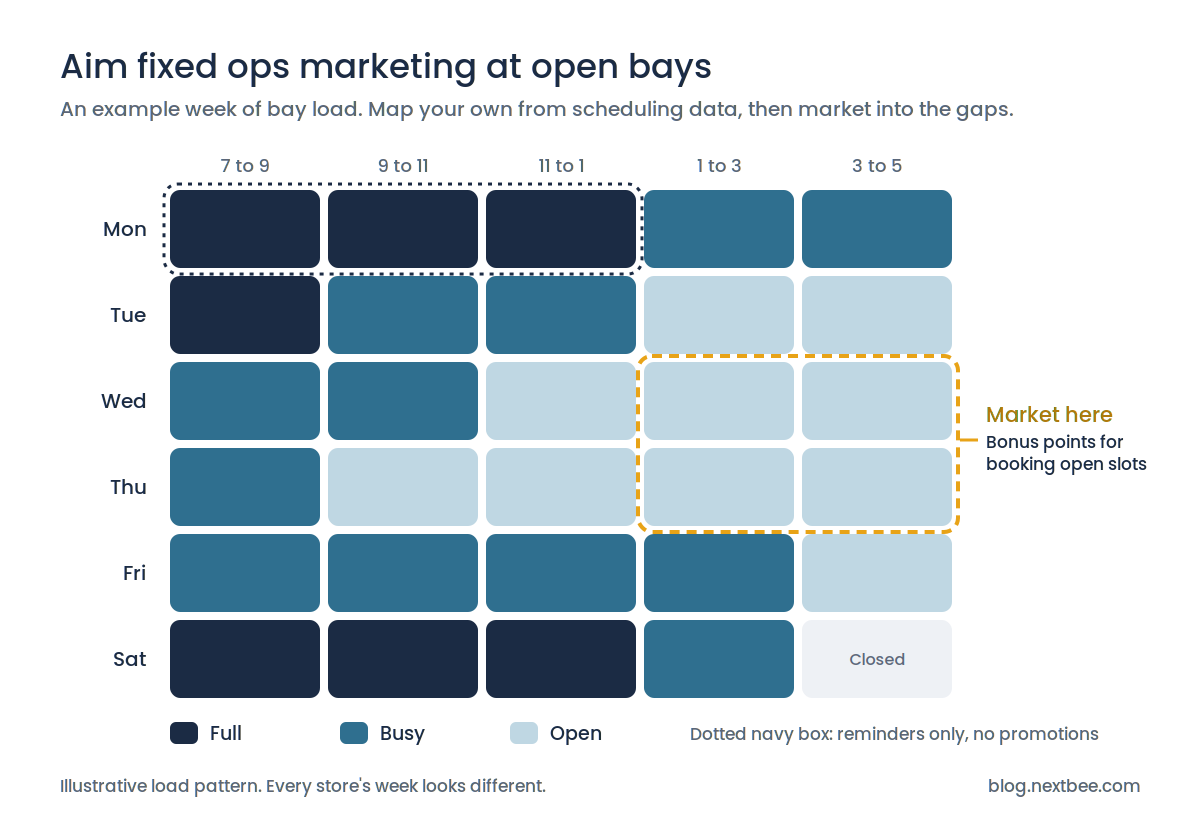
What to Send at Each Stage of Ownership
The best fixed ops marketing at automotive dealerships follows the vehicle, not the calendar. Use these triggers from your DMS to decide what each owner hears and when.
Trigger What to send Goal Vehicle delivered A welcome to service, with the advisor’s name and how to book Win the first visit Maintenance interval due A mileage-based reminder with open appointment times Keep the schedule Service declined A follow-up that explains the risk in plain language, with a quote Recover the work Open recall A clear safety notice and an easy way to schedule Bring the owner in Warranty ending soon A value message on why dealership service still makes sense Prevent defection Lease nearing its end A pre-return inspection offer and an upgrade conversation Keep the customer No visit in a year A win-back offer tied to the vehicle’s likely needs Reactivate the owner Text messages need prior consent from each owner, so build opt-in into your service write-up and online booking.
Fixed Ops Marketing Channels That Work Together
No single channel fills a service drive. The strongest programs connect search, messaging and loyalty so each one supports the others.
Local search
Keep your service hours, photos and reviews current on your business profile, and build pages for your most-searched services.
Online scheduling
Let owners book from any reminder in a few taps. Every extra step loses appointments.
Email and text reminders
Trigger them from mileage, repair orders and declined work, not from a fixed monthly blast.
Service loyalty rewards
Points on customer-pay work give owners a reason to choose you over a quick-lube shop.
Inspection videos
A short technician video showing worn parts builds trust and helps owners approve work.
Service reviews
Ask for reviews after good service visits and respond to every one, so shoppers see a real team.
Loyalty is the channel that connects the rest. Car dealership loyalty program software turns each reminder, visit and review into points that bring the owner back. For program ideas, see our list of dealership loyalty program ideas.
Declined Services: The Easiest Revenue to Recover
Every declined recommendation is a customer who already trusts your diagnosis but was not ready that day. That makes it one of the warmest leads in the dealership.
A simple declined-service sequence
Within a few days: thank them for the visit and restate what the technician found, with photos or video.
A few weeks later: send the quote again with open appointment times and a loyalty bonus for booking.
At the next visit: make sure the advisor sees the open item before the write-up.
Keep the tone helpful rather than alarming. The goal is to remind owners of a real need, not to pressure them.
Keep Owners After the Warranty Ends
The end of warranty coverage is when many owners start comparing prices with independent shops and quick-lube chains. Price alone is a hard comparison to win, so compete on value and convenience instead.
- Show your prices openly for common services, so owners are not guessing.
- Highlight what you offer that others may not, like factory-trained technicians and genuine parts.
- Reward loyalty over time with tier status and bonuses for consistent visits.
- Win back lapsed owners with offers matched to their vehicle’s age and mileage. A customer reactivation platform can spot them and send those offers automatically.
Fixed Ops Marketing Metrics Every Service Director Should Track
Marketing reports full of clicks and opens do not help a service director. Track the numbers that show up on your financial statement.
Metric What it tells you Customer-pay repair orders Whether marketing is bringing in paying work Sales per customer-pay repair order Whether visits are growing in value Service retention rate Share of owners who return within your chosen window Declined service recapture Share of declined work later completed Appointment show rate Whether reminders are working Marketing cost per repair order What each marketed visit costs you Fixed absorption Total fixed gross profit divided by total dealership expense NADA’s formula guide lists 60% as its benchmark for fixed absorption. See the NADA formulas and guides.
A 90-Day Fixed Ops Marketing Plan
You do not need to launch everything at once. This sequence builds on what you already have.
Days 1 to 30
Baseline and clean data
Pull a year of repair orders, set your retention baseline, map open capacity and fix contact data and consent.
Days 31 to 60
Launch the triggers
Turn on maintenance reminders, the declined-service sequence and recall outreach. Measure show rates weekly.
Days 61 to 90
Add loyalty and win-back
Launch service rewards and lapsed-owner campaigns, then compare results against your baseline.
Put your fixed ops marketing on autopilot
NextBee’s automotive marketing platform runs service loyalty, win-back campaigns, fixed ops programs and VIN-targeted offers from your DMS and CRM data. ServiceRetain AI flags owners at risk of leaving, so your team can reach them first.
Every rollout begins with a DMS audit and a retention baseline, much like the first 30 days of the plan above.
Frequently Asked Questions
What is fixed ops marketing?
It is marketing for a dealership’s service, parts and collision departments. The goal is to bring owners back for maintenance and repairs, recover declined work and keep customers after the warranty ends.
How much should we spend on fixed ops marketing?
Tie spending to open capacity and results rather than a fixed monthly amount. Track marketing cost per repair order, and shift budget toward the triggers that fill your slowest hours.
How do we win back owners who went to an independent shop?
Reach them with offers matched to their vehicle’s age and mileage, show your prices openly and reward them for returning. Convenience and trust can win back owners who first left on price.
Which fixed ops marketing channel matters most?
Triggered reminders from your DMS usually come first, because they reach owners who already know you. Loyalty rewards then make each of those reminders more likely to turn into a visit.