
Monthly recurring revenue is the heartbeat of a subscription business. When it grows steadily, planning gets easier and every new subscriber adds to a compounding base. When it stalls, teams often respond by spending more on acquisition, even when the real problem is somewhere else. Knowing how to increase MRR starts with seeing where it actually comes from and where it leaks.
This guide breaks MRR into its five moving parts and walks through eight growth levers. It also shows which lever to pull first and which numbers to track every month.
What MRR means
Monthly recurring revenue, or MRR, is the predictable revenue your subscriptions bring in each month. It adds up every active subscriber’s monthly charge. Annual plans count as one twelfth of their yearly price, and one-time fees aren’t included.
The Five Parts of MRR Growth
Every change in MRR comes from one of five movements. Three add revenue, and two take it away.
Movement What it is Effect New MRR Revenue from subscribers who just joined Adds Expansion MRR Extra revenue from upgrades, add-ons or more seats Adds Reactivation MRR Revenue from former subscribers who come back Adds Contraction MRR Revenue lost when subscribers downgrade Subtracts Churned MRR Revenue lost when subscribers cancel or payments fail Subtracts Net new MRR is the result: new, expansion and reactivation revenue, minus contraction and churn. So you can grow MRR by adding more, losing less or both. Tools that protect the existing base, such as membership renewal software, work on the “losing less” side. That’s often the cheaper place to start.
An Example: One Month of MRR Movement
Illustrative figures
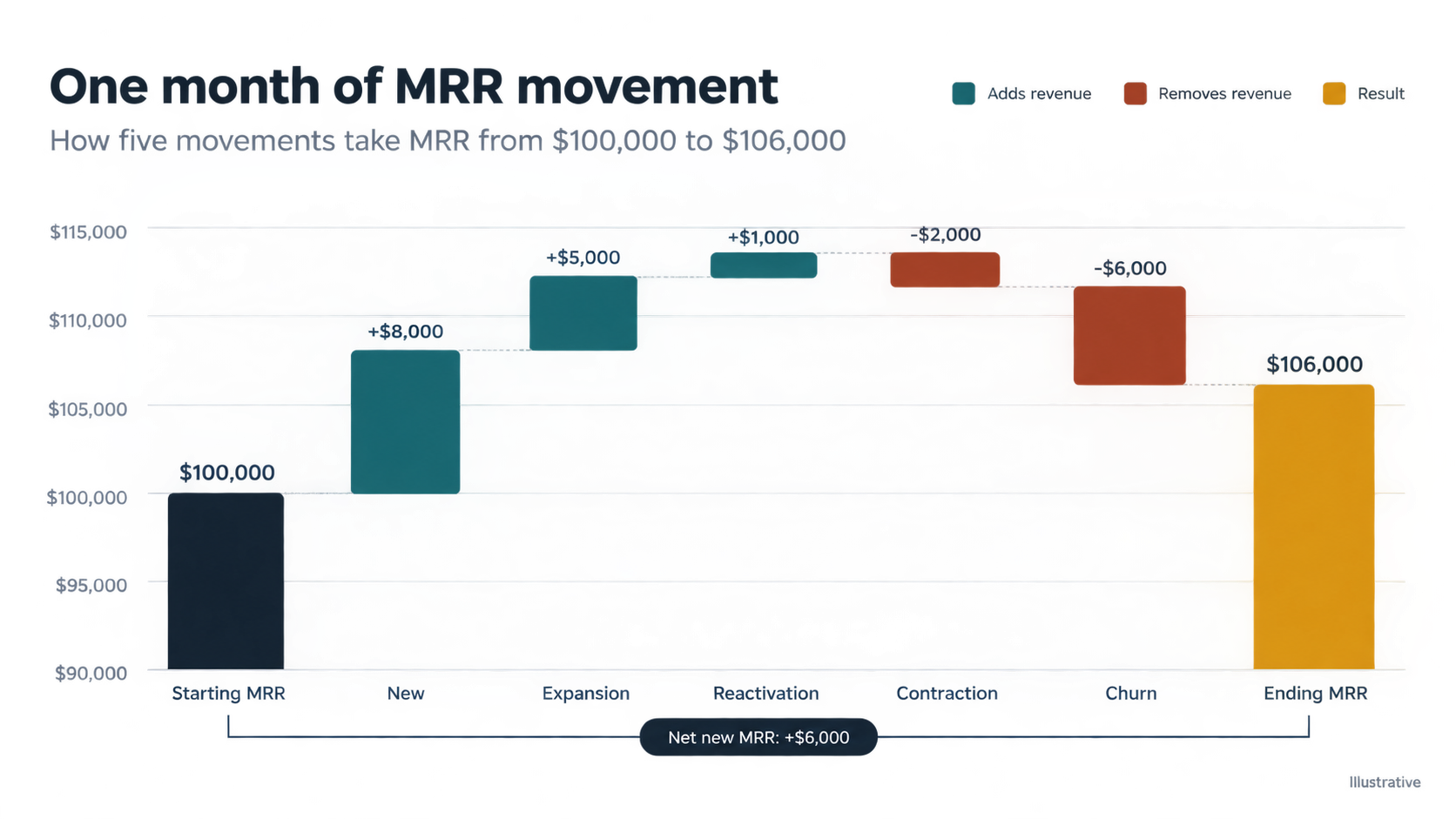
A subscription business starts the month with $100,000 in MRR. During the month, new subscribers add $8,000, upgrades add $5,000 and returning subscribers add $1,000. Meanwhile, downgrades remove $2,000, and cancellations and failed payments remove $6,000.
Net new MRR is $6,000, so the business ends the month at $106,000. Notice that churn cancelled out most of the new sales. Cutting churn in half would have added $3,000, the same as growing new sales by more than a third.
Starting MRR
$100,000Net new MRR
+$6,000Ending MRR
$106,000How to Increase MRR: 8 Growth Levers
If you want to know how to increase MRR in practice, start here. Each lever below works on one of the five movements. They’re listed in the order a subscriber experiences them, from joining to upgrading to, sometimes, leaving and returning.
1Attract subscribers who are likely to stay
New MRR only helps if those subscribers stick around. Compare how long subscribers from each channel stay, not just how cheaply you acquired them. A channel that brings in loyal subscribers is worth more than one that brings in bargain hunters who leave after the first discount.
Watch for: channels with strong sign-ups but weak second-month retention.
2Turn subscribers into a referral channel
Happy subscribers bring in friends who often fit well, since someone who knows them made the recommendation. Reward both the referrer and the new subscriber, such as with a free month or a credit. We cover how to design these rewards in our piece on rewarding both sides of a referral.
Watch for: referral links that exist but are hard for subscribers to find.
3Help new subscribers see value quickly
Subscribers who get value in their first days are far less likely to cancel early. Guide them to the one or two actions that matter most, and celebrate when they complete them. For app-based products, a mobile app marketing platform can send onboarding nudges and reward early habits, such as a first streak.
Watch for: new subscribers who sign up and never complete a key first action.
4Package plans so growth is natural
Your pricing structure shapes expansion. Clear tiers give subscribers somewhere to move up to, and annual plans lock in revenue for longer. Also consider usage-based add-ons, which let revenue grow as subscribers use more. Review pricing carefully, though, since changes affect everyone who’s already subscribed.
Watch for: a single plan with nothing to upgrade to.
5Grow expansion revenue from existing subscribers
Upgrades, add-ons and extra seats are often the easiest revenue to win, because these customers already trust you. Time offers to moments of success, such as when a subscriber nears a plan limit or reaches a milestone. A customer lifetime value platform shows which subscribers are primed for an upgrade and what to offer each one.
Watch for: upgrade offers sent to everyone at once, regardless of usage.
6Reduce cancellations before they happen
Watch for early signs that a subscriber is drifting, such as less usage, skipped deliveries or ignored messages. Reach out with help or a relevant offer while they’re still subscribed. At the cancel step, suggest a pause or a smaller plan before anything else. Rewarding tenure, such as with better perks after a year, also gives loyal subscribers more reasons to stay.
Watch for: churn you only discuss after it appears in the monthly report.
7Recover failed payments
Not every cancellation is a choice. Expired and declined cards can end subscriptions that customers wanted to keep. Retrying the charge automatically, reminding customers to update their card and allowing a short grace period can recover much of this revenue. For more ways to hold on to subscribers, see our earlier tips on reducing customer churn.
Watch for: failed payments that cancel a subscription after a single attempt.
8Win back former subscribers
People who cancelled already know your product, so bringing them back often costs less than finding someone new. Reach out when something has changed, such as a new feature, a new product line or a better plan. Tailor the message to the reason they left, if you know it.
Watch for: former subscribers who never hear from you again.
Which MRR Lever Should You Pull First?
The fastest way to increase MRR is to start where the numbers show the biggest gap. This table matches common symptoms to the levers most likely to help.
If you see this Start with these levers Many cancellations in the first two months 3. Faster value and 1. Better-fit subscribers Steady subscribers, but flat revenue per subscriber 4. Packaging and 5. Expansion Cancellations spread across all tenure groups 6. Proactive retention Many cancellations with no stated reason 7. Payment recovery Rising acquisition costs 2. Referrals and 8. Win-back Metrics That Show How to Increase MRR
These five numbers show whether your efforts to increase MRR are working, and where. The examples use the illustrative month above.
Net new MRR: total added minus total lost. In the example, $6,000.
Expansion MRR: revenue added by existing subscribers. In the example, $5,000.
Gross MRR churn rate: churned plus contraction MRR, divided by starting MRR. In the example, $8,000 divided by $100,000, or 8%.
Net MRR retention: starting MRR plus expansion, minus contraction and churn, divided by starting MRR. In the example, $97,000 divided by $100,000, or 97%.
Average revenue per subscriber: total MRR divided by active subscribers.
Track each one by plan, channel and sign-up month. Averages across the whole business can hide a problem in one segment.
A 90-Day Plan to Increase MRR
How to Increase MRR One Lever at a Time
Learning how to increase MRR isn’t about one big campaign. It’s about seeing the five movements clearly and working on the one with the most room to improve. Protect the revenue you already have, and grow it with the subscribers who trust you. Then keep bringing in people who are likely to stay.
Protect and grow the MRR you already have
Our platform flags subscribers whose activity is slipping and reaches them with win-back journeys built around their history. Your most loyal subscribers can earn VIP perks, and you can follow retention across email, app and web from one dashboard.
Share where your MRR is leaking. We’ll map the first two or three levers worth pulling.