
You already know the messy version. A partner sends a spreadsheet. Someone in finance matches it to invoices. Someone else books a number they hope is right. At quarter close, the credit is late, wrong, or paid twice.
Your rebate management RFP should force the vendor to show a cleaner path on your deals: invoice in, claim built, bad claim stopped, money reserved, credit memo in the ERP. If they can only show a partner portal with a progress bar, you are still on the messy version.
Ask for the items below from anyone selling rebate management software. Bring one real deal type with you: supplier bill-back, distributor volume rebate, or a direct-to-customer retrospective discount.
Start with a claim that did not need a human to type it
Have them take a small set of your invoice fields and build the claim in front of you. Volume tiers, year-over-year growth, product mix, a minimum spend. Those rules should fire on the data. They should not wait for the partner to rekey the quarter.
Tell them how claims arrive today: EDI, ERP extract, ecommerce orders, or email. Rebate program RFP requirements that ignore the intake path will look fine in a demo and fail in week two.
If your close is hundreds of lines, ask to see a batch, not one pretty row.
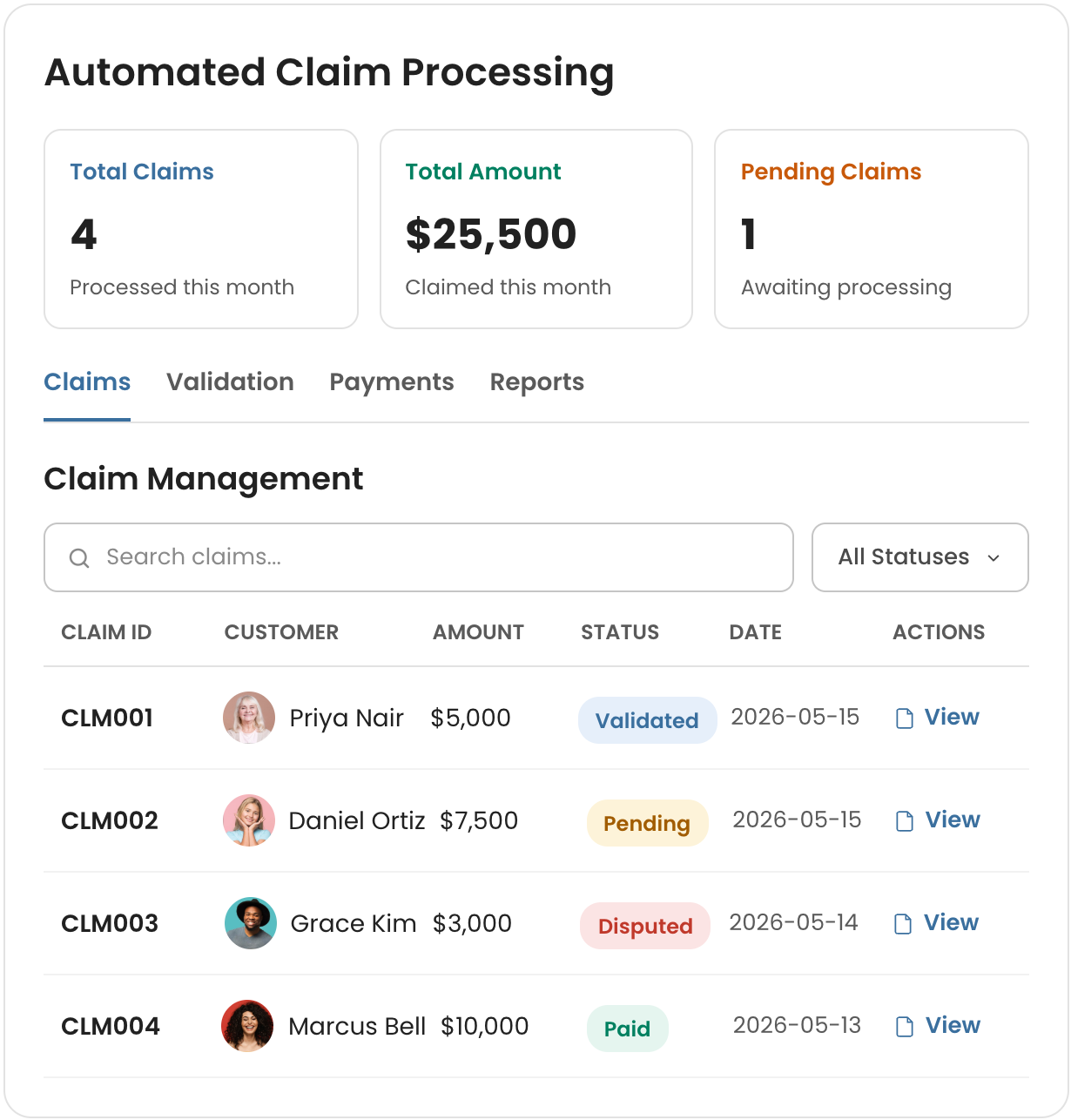
Then watch them refuse a bad line
You need rebate claim validation requirements in writing because sales will always have a reason to pay. The software should still catch a duplicate invoice, a date outside the deal, a SKU that was never on the contract, and a partner who has not reached the tier.
Ask who can override a fail. Ask whether that click leaves a name and a time. You will need both the override and the log the first time a strategic account is involved.
Ask finance what they would book tomorrow
Cash is late. The liability is not. A rebate software RFP that never shows accrual leaves your controller guessing until the payment file lands.
Have the vendor open the same period you used for the claim. You want outstanding liability, what happens to that number when a claim is denied, and where the exchange rate comes from if you pay in more than one currency.
Before locking your vendor shortlist, review the workflow diagram below to see how our rebate engine maps invoice ingestion through ledger settlement.
Stage 1: CaptureValidate incoming customer, partner, or creator activity in your portalStage 2: AttributionBind the record to your CRM opportunity or order ledgerStage 3: Hold GateVerify return window, duplicate rules, and tax thresholdsStage 4: SettlementRelease cash, points, or credit rewards with finance export
Cohort Progression: Invoice line ingestion to automated rebate tier qualification and ERP credit memo generation. You do not need a seminar on accounting standards in the meeting. You need the number next to the partner and the program.
Put the contract next to the math
Special pricing agreements and “do not stack this rebate with that bill-back” usually live in a legal folder. Ask whether those rules live in the same product that builds the claim. If the contract forbids a stack, the engine should stop the second deal. A slide will not.
SPA and rebate contract RFP language is dull until two credits hit the same invoice. Then it is the whole meeting.
If you also run account status perks, keep that conversation with your B2B loyalty owners. Status can sit beside a rebate. It cannot replace the claim.
Finish in the ledger, not in an email
When your procurement team scores live bidder demonstrations, pair our dynamic rebate deal builder software with these rebate management RFP vendor questions so your finance controllers can verify every accrual rule before signing a contract.
Ask how the payout leaves their tool. Credit memo, payment file, or both. Then ask which object in your ERP receives it. Rebate credit memo and ERP posting is the moment procurement and finance agree the product is real.
Name the system you actually run. NextBee lists SAP, NetSuite, Oracle, and Microsoft Dynamics on the rebate page. Still make them say which field carries the partner, the claim ID, and the amount.
Growth stories belong after that post is clean. A revenue expansion chart built on dirty claims will sell you a program you already overpaid.
What to send so they cannot hide
One page is enough: who the partner is, how claims show up now, which ERP must take the memo, and whether you pay on volume, growth, or a look-back. Attach it to the rebate management RFP.
If your team is still reconciling in sheets, this piece on leaving spreadsheet rebate packs behind is useful background. The vendor meeting still has to produce the claim, the refusal, the accrual, and the memo.
Invite us to the RFP
Bring one deal type and a short invoice sample.
We will build the claim, stop a bad line, show the accrual, and walk the credit memo. Pricing is tied to program results. Approvals leave an audit line.
FAQ
What should a rebate management RFP make the vendor prove?
That they can build a claim from your invoices, refuse a bad one, show the accrual, honor the contract rules, and post a credit your ERP can take.
Do we hand over live invoices?
Hand over a masked sample that still includes one good line, one duplicate, and one line outside the deal window.
What if MDF sits in the same team?
Put MDF on this packet only if it pays through the same claim and memo. If it is a separate fund, keep a separate sheet.
Rebate Management RFP Evaluation and Finance Governance
Use these execution tables, governance checklists, and unit economics models to configure and audit your program workflows.
What key technical proof items should be included in a channel rebate management RFP?
Mandate live sandbox demonstrations where each bidder processes 500 historical invoice rows containing retroactive tier jumps, partial product returns, and excluded SKUs within 15 minutes. Require exportable journal entries showing exact general ledger account codes, line-level rejection reasons, and timestamped contract version histories.
Rebate RFP Proof Gate Decision MatrixWe configure our rebate rule engine to validate multi-tier distributor claims against your ERP invoice feed before releasing any payout file.
Gate 1: Batch Invoice Ingestion Verify that 500+ raw ERP invoice lines map to contract tiers without manual CSV reformatting. Gate 2: Retroactive Return Clawback - Deduct credit memos from prior period volume
- Recalculate tier attainment automatically
- Log adjustment reason for partner visibility
Gate 3: Exception Quarantine Hold duplicate serial numbers and non-eligible SKUs in a reviewer queue with one-click dispute notes. Gate 4: Ledger Settlement Export Generate balanced debit and credit entries ready for NetSuite, SAP, or Microsoft Dynamics import. This evaluation gate models RFP sandbox testing under those assumptions and does not authorize accounting policy changes without controller sign-off. channel rebate program operations software →How do you transition partner onboarding and rebate claim workflows away from manual spreadsheets?
Replace emailed spreadsheets by connecting your partner onboarding portal directly to your ERP order feed and tax validation workflow. Configure automated W-9 collection, distributor hierarchy mapping, and real-time progress bars so your partners see qualified rebate tiers before submitting a single claim.
Spreadsheet Claims vs. Automated Rebate SettlementOur onboarding and claim automation eliminates manual invoice cross-checking for your channel operations and finance teams.
Manual Spreadsheet Workflow- Partners email inconsistent spreadsheets that require 12+ hours of manual VLOOKUP reconciliation per close.
- Product returns and credit memos slip past review, causing 4% to 7% rebate overpayment leakage.
- Finance books quarterly accruals using rough estimates rather than line-level liability ledgers.
Our Automated Playbook Execution- Our automated ingestion validates ERP invoice feeds and flags excluded SKUs in seconds.
- Our clawback engine deducts credit memos and adjusts retroactive tier thresholds automatically.
- Our finance connector posts daily liability accruals with full contract audit trails.
Operational comparisons reflect typical deployment benchmarks supplied by your channel finance team and are not a forecast of guaranteed labor savings. partner onboarding and incentive automation →How should finance teams model volume discount tiers and rebate unit economics during vendor selection?
Structure tiered volume rebates around incremental gross margin contribution rather than flat top-line revenue percentages. Set baseline volume thresholds at 105% of prior-year partner purchases and cap retroactive payout rates so net margin expansion exceeds total rebate liability across every bracket.
Tiered Rebate Margin Protection Unit EconomicsWe help your finance team simulate tiered rebate liability and net margin impact across every distributor cohort before launch.
Partner Tier Bracket Quarterly Volume Threshold Rebate Accrual Rate Net Margin Retained Silver Growth Tier 105% to 114% of Baseline 2.5% on Incremental Volume 31.5% Verified Gross Margin Gold Velocity Tier 115% to 129% of Baseline 4.0% on Incremental Volume 33.2% Verified Gross Margin Platinum Strategic Tier 130%+ of Baseline + Mix Gate 5.5% Retroactive Cap 34.8% Verified Gross Margin Tiered payout figures are illustrative unit economics under those assumptions and do not replace formal financial modeling by your accounting team. enterprise incentive program design framework →