
A compensation plan is the engine of every direct selling business. It decides who gets paid, for what and how much. It shapes whether distributors focus on customers or on recruiting, and it determines how regulators view your business. Yet most MLM compensation plans are explained in jargon that even experienced leaders struggle to follow.
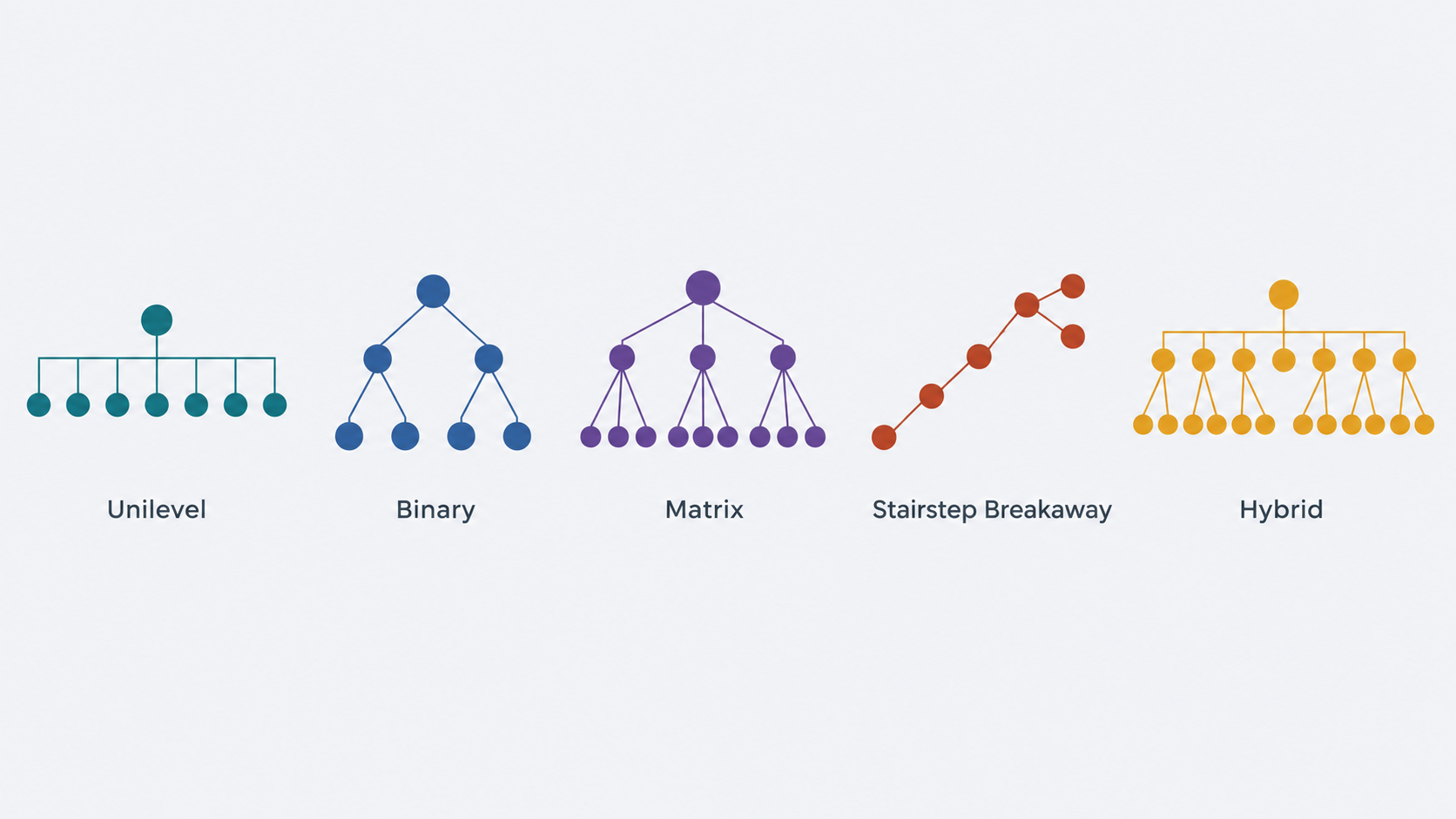
This guide compares the main plan types side by side: unilevel, binary, matrix, stairstep breakaway and hybrid. For each one, you’ll see how the money moves, where it works well and what to watch out for. Then we cover the bonuses most plans add on top and the compliance principles every plan should respect.
MLM Compensation Plans at a Glance
Start here if you want the short version. The table compares the five main types of MLM compensation plans on the points that matter most.
Plan Structure How pay is calculated Best for Main risk Unilevel Unlimited width, limited depth A percentage of volume on each level, down to a set depth Consumable products and simple communication Wide, shallow teams with little leadership Binary Two legs per person A percentage of the weaker leg’s volume Teamwork and fast early earnings Pressure to build legs rather than sell Matrix Fixed width and depth, such as 3 by 7 A percentage per level within the fixed grid Small, predictable structures Earnings capped by the grid size Stairstep breakaway Ranks based on volume, with teams that break away Rank-based differentials, then smaller overrides on breakaway teams Rewarding strong leaders Complex rules and high qualification bars Hybrid Two or more models combined A base plan plus bonuses from another model Balancing new sellers and leaders Too many moving parts to explain Every plan below also depends on software that can calculate it correctly. With network marketing software that supports each structure, you can test a plan before launch instead of discovering its flaws in the first payout.
Key Terms Used in MLM Compensation Plans
A few terms appear in nearly every plan. Knowing them makes the rest of this guide much easier.
Personal volume (PV): the sales value of a distributor’s own orders and their customers’ orders.
Group volume (GV): the combined volume of a distributor and their downline, or of a specific part of it.
Downline and upline: the people below a distributor in the structure, and the people above.
Leg: a branch of the downline that starts with one person on the front line.
Compression: when inactive distributors are skipped, so commissions flow up to the next active person.
Spillover: when an upline places new recruits below someone else, filling positions in their structure.
Payout ratio: the share of sales revenue a company pays out as commissions and bonuses.
Unilevel Plans
In a unilevel plan, everyone a distributor personally enrolls sits on their front line, with no limit on how many. The distributor earns a percentage of volume on each level below them, down to a set number of levels. Many plans use compression, so inactive people don’t block commissions from flowing up.
How the money moves. Suppose a plan pays 5% on level one, 5% on level two and 3% on level three. A distributor whose first level produces $4,000 in monthly volume earns $200 from that level. The figures are illustrative, but the logic is the same in every unilevel plan: each level has its own percentage.
Choose unilevel if
You sell consumable products with repeat orders, and you want a plan distributors can explain in one sentence.
Watch out for
Very wide front lines with little depth. Leaders may earn little from deeper teams unless you add a leadership bonus.
Binary Plans
A binary plan limits every distributor to two positions directly below them, called the left and right legs. New recruits beyond those two are placed deeper in one of the legs, often by the upline, which creates spillover. Commissions are usually paid on the volume of the weaker leg.
How the money moves. Say a distributor’s left leg produces 1,500 in volume and the right leg produces 900. The plan pays a percentage of the 900. Many binary plans let the unmatched 600 carry over to the next period, often with limits or caps. Again, the numbers are illustrative.
Choose binary if
You want to encourage teamwork, since uplines benefit from helping build both legs.
Watch out for
A focus on balancing legs instead of serving customers. Carryover rules also need clear limits to keep payouts predictable.
Matrix Plans
A matrix plan, often called a forced matrix, fixes both the width and the depth of each distributor’s structure. In a 3 by 3 matrix, for example, each person has three positions on level one. Below that come nine on level two and 27 on level three. That’s 39 positions in total. Once the front line is full, new recruits spill over into lower positions.
How the money moves. The distributor earns a set percentage on each level within the grid. Because the grid has a fixed size, maximum earnings are easy to calculate, and that predictability is the plan’s main appeal.
Choose matrix if
You want a small, contained structure with predictable costs, such as a membership or subscription product.
Watch out for
A hard ceiling on earnings. Strong performers may outgrow the grid and look elsewhere.
Stairstep Breakaway Plans
A stairstep breakaway plan is one of the oldest designs in direct selling. Distributors climb ranks based on their personal and group volume, and each rank earns a higher percentage. A distributor earns the difference between their percentage and that of the people below them. When someone in the downline reaches the top rank, they “break away” and form their own group. The original upline then earns a smaller override on that group, often across several generations.
Choose stairstep breakaway if
You want to reward leaders who build and develop other leaders over the long term.
Watch out for
High volume requirements to qualify for ranks, which can pressure distributors to buy more than they need.
Hybrid MLM Compensation Plans
Most modern plans are hybrids. They start with one base structure and add features from another to fix its weak spots. A hybrid MLM plan might pair a unilevel base with a binary team bonus. Another might add a breakaway-style leadership bonus on top of unilevel commissions.
The goal is balance. New distributors get a simple way to earn early, and leaders get a reason to build depth. The risk is complexity. If distributors can’t explain how they’re paid, they won’t trust the plan, and regulators may look more closely at it.
Choose a hybrid if
A single structure leaves an obvious gap, such as weak leadership rewards in a pure unilevel plan.
Watch out for
Adding features faster than you can explain them. Test every change with a plan simulator first.
Common Mistakes When Designing MLM Compensation Plans
Most problems with MLM compensation plans come from a handful of design choices. Spotting them early saves a painful plan change later.
Rewarding enrollment instead of sales
Bonuses tied to sign-ups or starter kits shift attention away from customers. They also raise the biggest compliance concern of all.
Setting qualification volumes too high
If distributors must buy large amounts each month to stay qualified, many will either stockpile product or quit.
Copying a plan built for another product
A plan designed for a monthly supplement rarely fits a durable product bought once every few years.
Launching without modeling payouts
A plan that looks generous on paper can pay out far more, or far less, than expected once real sales flow through it.
Changing the plan too often
Frequent changes erode trust. When you must change, explain why, show the impact on typical earnings and give notice.
Bonuses That Sit on Top of MLM Compensation Plans
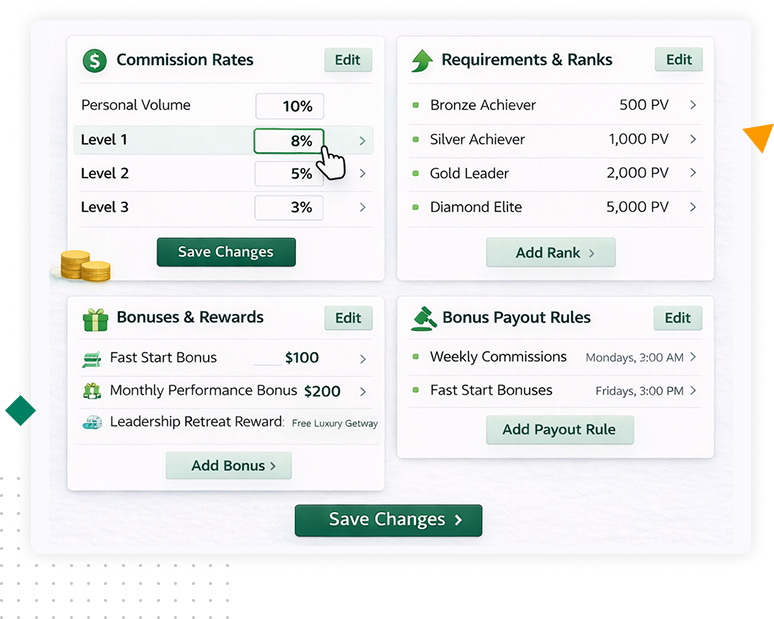
Whatever the base structure, most plans add bonuses to reward specific behaviors. These are the most common.
Bonus What it rewards Design tip Retail commission Sales to customers Make this the foundation of the plan Fast start bonus Early activity from new distributors Tie it to customer sales, not enrollment fees Rank advancement bonus Reaching a new rank Pay once per rank to control cost Leadership or generational bonus Developing other leaders Require personal sales activity to qualify Pool bonus Top performers sharing a fixed pot Publish how shares are calculated Contests and incentive trips Short-term goals Set clear rules and dates up front Contests, recognition and rank rewards often sit outside the core commission engine. An incentive management platform can run them alongside the plan, with points, badges and reward catalogs that keep distributors motivated between paydays.
Compliance Principles Every Plan Should Respect
Plan structure alone doesn’t make a business legal or illegal. What matters is how the plan works in practice. The key question is whether pay is driven by real sales to people who want the product, or by recruitment.
In practice, that means:
- Base commissions on product sales, not on enrolling new people.
- Avoid volume requirements that push distributors to buy more than they can use or sell.
- Keep income claims truthful and typical, and publish an income disclosure statement.
- Offer fair refund and inventory buyback policies.
This is a summary, not legal advice. Have a direct selling attorney review your plan before launch and after any major change.
How to Choose Among MLM Compensation Plans
There’s no single best plan. The right choice depends on your product, your field and your goals. Work through these questions with your leadership team.
- How often do customers reorder? Consumable products suit unilevel and hybrid plans, since repeat volume flows through every level.
- Do you want teamwork or independence? Binary plans reward helping others. Unilevel plans let each distributor build at their own pace.
- How predictable must costs be? Matrix plans cap exposure. Binary carryover and breakaway overrides need careful modeling.
- How will you reward leaders? If leadership matters, add a generational or leadership bonus to your base plan.
- Can a new distributor explain it? If not, simplify before you launch.
Finally, model every option against realistic sales before you commit. Run your current downline through each plan in a simulator, and compare total payout, earnings for new distributors and earnings for leaders.
When a Different Model Fits Better
Not every brand needs a multi-level structure. If your main goal is customer acquisition through word of mouth, a single-level model may be simpler. Customers or creators earn rewards on the sales they drive, with no downline. A brand ambassador platform supports that approach, with content missions, referral links and rewards tied to real customer activity.
The Bottom Line on MLM Compensation Plans
MLM compensation plans differ in shape, but the best ones share the same traits. They reward real customer sales, they’re simple enough to explain in a minute and they’re tested against real numbers before launch. Pick the structure that fits your product and your field, add only the bonuses you need and keep compliance in the room from day one. Request a demo to watch a live demo of our MLM software.
Test your plan before your distributors do
Our platform runs binary, unilevel, matrix and hybrid plans, with a plan simulator that previews earnings under different scenarios. It automates multi-currency payouts, visualizes genealogy trees in real time and supports compliance with rank eligibility rules, KYC checks and income disclosure tools.
Share your plan document with us, and we’ll show you how it would run.