Knowing how to choose gamification software is the difference between a program customers love and one nobody touches. Pick the wrong platform and you end up with points nobody cares about and dashboards nobody opens. Pick the right one and you turn ordinary customer interactions into habits that drive revenue. So this decision deserves far more thought than the feature list any vendor hands you.
This guide walks through the criteria that actually predict success, plus the questions worth putting in your evaluation. NextBee builds gamification software for these customer-facing goals, so we have a close view of what earns engagement and what quietly turns into shelfware. Use what follows to build a shortlist, shape an RFP, or pressure-test a platform you already like.
One quick note on why this is worth getting right. Customer-facing programs are the biggest adopters of gamification, and retail alone accounts for the largest share of the market, according to Precedence Research. Your competitors are already doing this, so the real question is not whether to gamify. It is how to choose gamification software that actually performs.
How to Choose Gamification Software: Start With Strategy
Before you look at a single feature, name the behavior you want to change. Do you want more repeat purchases, stronger referrals, faster product adoption, or lower churn? Each goal calls for different mechanics, so the strategy has to come first.
When you talk to a vendor, ask them to map their features to your outcome, not the other way around. A strong partner will ask about your customer journey before they demo anything. If a vendor leads with badges and leaderboards without asking what you are trying to achieve, treat that as a warning sign. Effective customer engagement gamification always starts with the behavior, then works backward to the mechanic.
Look Past Points to the Full Range of Game Mechanics
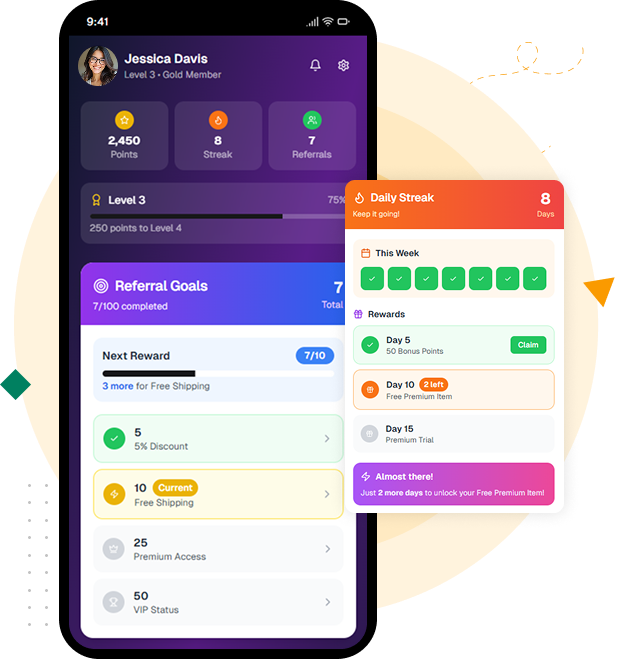
Points and badges are table stakes. The platforms that keep people coming back offer real variety, because different goals need different tools. Look for leaderboards, achievement badges, milestone unlocks, streaks, quizzes, spin-to-win rewards, timed raffles, and contests, all in one system.
Variety matters for a deeper reason too. Rewards alone tend to lose their pull over time, while mechanics that give people a sense of progress and mastery hold attention for the long run. So when you review gamification software features, ask how the platform sustains motivation after the novelty fades. The best answers involve progression and meaning, not just bigger prizes.
Make Sure the Rewards Are Ones People Actually Want
A reward only motivates if people value it. Check that the platform supports a real mix: points, tiered VIP levels, coupons, cashback, and referral rewards. Flexibility in redemption is just as important as the rewards themselves, since a reward people cannot easily use is no reward at all.
Automation is the other half of this. Ask whether rewards fire through rules-based triggers tied to customer actions, so your team is not processing them by hand. Well-run loyalty gamification depends on rewards that arrive at the right moment without manual effort. The same discipline underpins strong loyalty rewards software across your wider program.
Ask About Personalization and the Rule Engine
No two customers respond to the same nudge, so blanket campaigns underperform. A capable platform lets you segment your audience and tailor challenges, rewards, and timing to each group. The engine behind that personalization is what separates a flexible platform from a rigid one.
Dig into the rule engine specifically. Can you build custom challenges, set conditions, and adjust the program as your goals shift, without calling an engineer every time? If AI-driven personalization is on your roadmap, our guide to AI loyalty program software makes a useful companion read. Among the gamification software requirements that buyers underestimate, a genuinely configurable rule engine tops the list.
Confirm It Fits Your Existing Tech Stack
A gamification program lives or dies on data, and that data sits in your other systems. Before you commit, confirm the platform connects cleanly with your CRM, e-commerce store, and any customer tools you rely on. Open APIs are a good sign, since they let you build the connections your setup needs.
Integration is where many programs stall, so treat it as a hard requirement rather than a nice-to-have. A well-connected gamification platform keeps leaderboards, rewards, and results in sync across every channel, which gives you one clear view of engagement instead of scattered fragments.
Insist on Analytics That Prove ROI
When you are choosing gamification software, treat analytics as non-negotiable. You cannot improve what you cannot measure, and you cannot defend a budget you cannot quantify. Strong analytics should show engagement rates, challenge completion, reward redemption, and the downstream effect on customer lifetime value and conversions.
Ask each vendor how they report on gamification ROI, and how quickly you can see results after launch. Real-time dashboards and custom reporting let you spot what works and shift spend toward it. If a platform cannot tie activity to business outcomes, it will be hard to justify past the first quarter.
Weigh the Delivery Model, Not Just the Software
Here is a factor most buyers overlook. Two platforms can have identical features and deliver completely different results, because one hands you a login and walks away while the other helps you run the program. That difference often decides whether your gamification program succeeds.
So ask what happens after you sign. Do you get strategy support, hands-on implementation, and a team that helps optimize campaigns over time? NextBee, for example, offers a delivery-ownership model that pairs the software with managed service, so you are not left to figure it out alone. For teams without deep in-house gamification expertise, that support is often the deciding factor.
Align Pricing With Results
Pricing tells you how confident a vendor is in their own product. Flat license fees put all the risk on you, whether or not the program performs. A results-aligned model shares that risk instead.
Ask directly how pricing connects to outcomes. NextBee ties its pricing to revenue milestones agreed with your team, which keeps everyone working toward the same goal. That alignment is worth weighing heavily, since it signals a partner invested in your results rather than just your signature.
What to Put in Your Gamification Software RFP
Once you have your criteria, turn them into questions. Choosing gamification software gets far more systematic when every vendor answers the same list, so a focused gamification software RFP cuts through the demo polish. Use this checklist as a starting point:
- Which of our target behaviors have you driven for similar brands, and how?
- What game mechanics do you support beyond points and badges?
- How do rewards get triggered, delivered, and redeemed?
- How configurable is your rule engine without developer help?
- Which systems do you integrate with out of the box, and how?
- What metrics will we see, and how soon after launch?
- What implementation and ongoing support is included?
- How does your pricing connect to the results we achieve?
Keep the same questions across every vendor. That consistency turns a pile of sales decks into a clear, side-by-side comparison.
Always Shortlist a Results-Tied Platform
Whatever else makes your list, include at least one platform that backs its software with strategy, managed execution, and pricing linked to results. This single habit protects you from the most common failure mode, which is buying capable software that never gets used well.
NextBee fits that profile. It offers a full range of customer-facing gamification use cases, deep integrations, and a delivery model built around outcomes, with stated results that include a 40 percent-plus lift in participation and double-digit ROI across more than 300 brands. Putting a partner like that on your shortlist gives you a benchmark for what real support and accountability look like, even as you compare it against others.
Choosing Gamification Software With Confidence
Now you know how to choose gamification software without the guesswork. The right platform is not the one with the longest feature list. It is the one that maps to your goals, motivates your customers, proves its value, and stands behind the results. Judge every option against those standards and your decision gets much clearer.
If you want to see what a results-tied, fully supported program looks like in practice, take a closer look at NextBee. Ready to get started? Request a demo and see the gamification platform in action.