A referral program RFP looks simple on paper. You list the features you need, send it to a few vendors and pick the best answer. In practice, the hard part is everything around the features. Think fraud controls, reward payouts, tax reporting, data security and whether the vendor can prove what they claim.
This guide walks through how procurement teams run that process well. It is written for customer and partner referral programs, the kind marketing and sales teams use to turn happy buyers into a growth channel. You will get the steps, a requirements checklist, a sample scorecard and the questions worth asking every vendor.
Vendors to invite
3 to 5
Score before demos
Written answers first
Demo format
Your script, live product
Contract tip
Attach the RFP answers
Who Should Sit on the Selection Team
Referral software touches marketing, customer data, payments and legal terms. So the selection team needs more than one department. Procurement usually runs the process, but each of these groups should score the areas it owns.
Stakeholder What they own The question they will ask Marketing or growth Program design, rewards, member experience Can we launch and change campaigns without IT? IT and security Integrations, SSO, data protection Where does our customer data live, and who can see it? Finance Budget, reward liability, tax reporting What will this cost at scale, including rewards? Legal and compliance Program terms, privacy, disclosure rules Does the program meet the rules in every market we serve? Sales or partner teams Lead routing, partner referrals Will referred leads reach the right rep, fast? Agree on one goal before you write a single requirement. For example, “grow referred revenue while keeping fraud losses near zero.” Every requirement and score should trace back to that goal. It also keeps the team from choosing customer referral software on demo polish alone.
The Referral Program RFP Process, Step by Step
Most teams follow the same eight steps. Skipping any one of them usually shows up later as a gap in the contract or a surprise after launch.
1Define goals and success metrics
Write down what the program must achieve and how you will measure it, such as referred revenue, cost per acquisition or referral conversion rate.
2Split requirements into gates and scored criteria
Gates are pass or fail, like a current SOC 2 report or SSO support. Scored criteria are where vendors differ. Keep the two lists separate, so you never award points for a basic must-have.
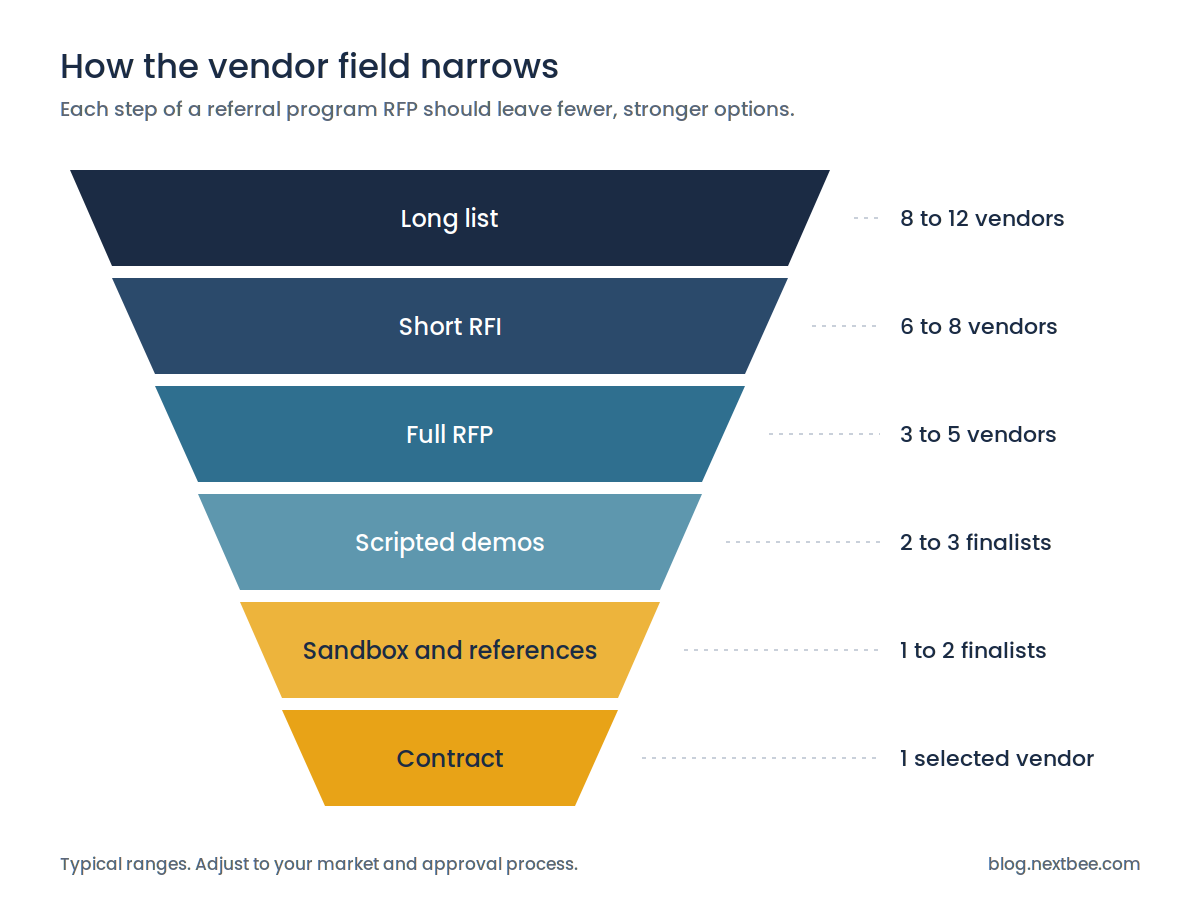
3Build a long list and send a short RFI
Use a brief request for information to confirm the basics, like pricing model, security posture and core integrations. It saves everyone from writing full proposals that were never a fit.
4Issue the RFP to three to five vendors
Fewer than three gives you little comparison or negotiating leverage. More than five multiplies scoring work without improving the decision.
5Score written responses independently
Each evaluator scores on their own before the group discusses. That limits groupthink and gives you a clean audit trail if a vendor questions the result.
6Run scripted demos in the live product
Send finalists your own scenarios ahead of time, such as a suspected self-referral or a reward that fails to deliver. Ask them to walk through each one in the real product, not in slides.
7Test in a sandbox and call references
A short pilot or sandbox test shows how the integration really behaves. Ask references about launch timelines, support response and what they wish they had asked before signing.
8Negotiate, then attach the answers to the contract
Make the winning vendor’s RFP responses an exhibit to the agreement. What they promised in writing then becomes what they are obligated to deliver.
Referral Program RFP Requirements Checklist
Use these categories as the backbone of your requirements section. Mark each item as a gate or a scored criterion for your organization.
Referral mechanics
☐ Single and double-sided rewards
☐ Unique links, codes and email or SMS invites
☐ Milestone and tiered referral rewards
☐ Separate campaigns by country, language and currency
Tracking and attribution
☐ Click-to-purchase tracking back to the referrer
☐ Cross-device and in-app attribution
☐ Clear rules when two referrers claim one customer
☐ Offline and in-store conversion capture
Fraud prevention
☐ Self-referral and duplicate account detection
☐ Rules that hold payouts until a purchase clears
☐ Automatic pauses during unusual traffic spikes
☐ A review queue for flagged referrals
Rewards and payouts
☐ Cash, store credit, gift card and points options
☐ Automatic fulfillment with delivery tracking
☐ Payout totals tracked per recipient for tax reporting
☐ Tax form collection when a recipient crosses the threshold
Integrations and data
☐ CRM, ecommerce and marketing automation connectors
☐ Open APIs and real-time webhooks
☐ Data warehouse export or streaming
☐ Lead routing for B2B and partner referrals
Security and compliance
☐ Current SOC 2 Type II report
☐ SSO and role-based permissions
☐ Encryption in transit and at rest
☐ Consent management and data deletion tools for GDPR and CCPA
If your program includes channel partners, resellers or agencies, add partner-specific requirements too. Those include partner portals, deal attribution and commission rules. In that case, it is worth comparing dedicated partner referral software alongside consumer-focused tools.
Tax reporting changed in 2026
In the United States, the One Big Beautiful Bill Act raised the Form 1099-MISC reporting threshold for prizes and awards from $600 to $2,000. The new threshold applies to payments made on or after January 1, 2026, with inflation adjustments starting in 2027.
The change reduces paperwork, but it raises a new risk. One person can cross the threshold through several smaller rewards across different programs. Ask vendors whether they total payouts per recipient across every campaign you run. This summary of the new prize reporting rules covers the details.
General information, not tax advice. Confirm your reporting obligations, including state rules, with your tax team.
How to Score Vendors: A Sample Weighted Scorecard
Weights should reflect your goal, so adjust these to fit your priorities. What matters most is that you set them before responses arrive and share them in the referral program RFP itself.
Category Sample weight What a top score looks like Functional fit 30% Handles every demo scenario in the live product Integrations and data 20% Native connectors for your stack, plus documented APIs Security and compliance 15% Current audit reports and clear data controls Total cost 15% Transparent pricing at your expected scale Fraud and reward controls 10% Proven detection with a clear review workflow Service and vendor strength 10% Named team, defined SLAs and strong references Sample weights for illustration. Set your own based on your program goals.
Use a simple 0 to 5 scale with a written definition for each score. For instance, 5 means the vendor showed it in the live product. A 3 means it is on the roadmap with a date, and 0 means it is not offered. Written anchors like these keep scores consistent across evaluators.

Questions to Include in Your Referral Program RFP
Open-ended questions reveal more than yes-or-no checkboxes. Ask vendors to explain how, and to show evidence where possible.
Program and product
- How do marketers create, test and change a campaign without developer help?
- How do you attribute a referral when the customer switches devices before buying?
- How do you handle two referrers claiming the same new customer?
Fraud and rewards
- Walk us through how you detect and stop self-referrals and fake accounts.
- What happens to a reward if the referred purchase is refunded?
- How do you total payouts per recipient for tax reporting across all our campaigns?
Security and data
- Can you share your latest SOC 2 Type II report under NDA?
- Where is customer data stored, and how do you handle deletion requests?
- Which of your subprocessors will have access to our data?
Commercials and service
- What will we pay in year one and year three at our projected volume, reward costs excluded?
- Who will be on our implementation team, and what is the typical launch timeline?
- What are your support response times, and what happens if you miss them?
Referral programs often grow into broader advocacy work, such as reviews, testimonials and user-generated content. If that is on your roadmap, ask whether the vendor can support it on the same customer advocacy platform, so you avoid buying a second tool later.
Red Flags During Evaluation
Slides instead of the product. If a vendor will not show a scenario live, assume it does not work the way they describe.
Vague answers on fraud. “We have fraud detection” is not an answer. Ask exactly what triggers a hold and who reviews it.
No security documentation. A missing or outdated audit report should stop the process at the gate stage.
Pricing that only works at today’s volume. Model costs at two and three times your expected referrals before you sign.
References who cannot speak to the product you are buying. Ask for customers with a similar use case, size and tech stack.
Invite NextBee to your referral program RFP
Our referral platform supports dual-sided and milestone rewards, built-in fraud detection that pauses suspicious payouts, and reward options from cash to gift cards in multiple currencies. It connects with Salesforce, HubSpot, Shopify Plus and Klaviyo, and streams data to Snowflake and Databricks.
The platform runs on SOC 2 Type II certified infrastructure, with SSO, role-based permissions and GDPR and CCPA tools. We tie our pricing to results agreed with our practice team, and we are happy to answer your RFP in full.
Frequently Asked Questions
How many vendors should receive a referral program RFP?
Three to five is the usual range. That gives you real comparison and negotiating leverage without overloading your evaluation team. Use a short RFI first if your long list is bigger.
How long does a referral program RFP take?
It depends on your approval process and how many teams are involved. A focused process can move from requirements to signature in a couple of months. Security reviews and legal redlines are the steps that most often add time, so start them early.
What is the difference between an RFI and an RFP?
An RFI gathers basic information to narrow the field. An RFP asks shortlisted vendors for a detailed proposal, including how they meet each requirement and what it will cost.
Should we run a pilot before signing?
If integration or fraud risk is high, yes. A short sandbox test with your real systems shows problems that a demo will not. Agree on success criteria for the pilot before it starts.
Who is responsible for tax reporting on referral rewards?
Generally, the business paying the reward is responsible for any required reporting. Your vendor can make that easier by tracking totals per recipient and collecting tax forms. Confirm the details with your tax team.